Showing posts with label lonely planet. Show all posts

Tuesday, July 15, 2008

Booking with the Beeb

LonelyPlanet.com has announced a new accommodation booking service in partnership with Expedia Distribution and hostelworld.com.

Travolution reported last week that BBC Worldwide paid c£90m cash for a 75% stake in LonelyPlanet late last year, with a view to exploiting the profit potential of the web site. The commercial terms of the deal with Expedia Distribution and hostelworld.com are not disclosed (‘twas ever thus) but it’s a start to monetizing a site which has 4.6m unique users.

Lonely Planet prides itself on the independence and quality of its advice by using a team of 360 professional writers to review hotels and hostels. But if the site is to become a profit centre in its own right there are many dangers to this independence. When deciding which hotels to review, will LP be more inclined to look at properties which it can sell? If ‘Martin’s B&B’ isn’t available through the partners, but ‘Kev’s B&B’ next door is, which one is the most likely to get a write-up on the site?

Martin Cowen, chief writer, Travolution

Sunday, June 08, 2008

BBC travel portal - just fancy that

The Sunday Times reports how listings giant Time Out is joining a growing list of companies angry over the BBC's acquisition of Lonely Planet.

There are concerns that the licence fee funded broadcast giant will use its expertise to develop the global travel guide publisher Lonely Planet, a direction Time Out boss Tony Elliott is understood to have said is "beyond the resources of any privately funded organisation".

Lonely Planet, in turn, may well help the BBC develop a travel portal of its own to run similarly to its motoring and environmental channels on the website.

People really shouldn't be surprised at such a turn of events. The BBC didn't buy LP because of a deep-seated love of backpacking!

And it would take a messy intervention from the likes of the UK's Office of Fair Trading to put a stop to it.

Kevin May, editor, Travolution

Monday, April 14, 2008

When fake reviews make the headlines

Lonely Planet will be hoping for a better start to next week.

Oh dear...

Kevin May, editor, Travolution

Thursday, January 31, 2008

Expedia and Firefox - maybe we missed the memo

Dedicated Firefox users here at Travolution Towers, primarily for its tabbed pages and multi-search engine toolbar (yes, IE7 does this but we're luddites and old habits die hard).

Anyway, we discovered this morning that users can add an Expedia search button to their Firefox toolbar.

For example, type in "Las Vegas" into the box and a list of hotel options for the Nevada city are displayed (data comes from the US Expedia site).

It also produces options for flights if you type in the airport codes. - although it gueses the departure dates).

One wonders how much use this toolbar gets. Other add-ons, we suspect, like BBC News, USA Today and Amazon, probably get a lot more traffic. But that's probably not the point either...

Other travel-related add-ons include Lonely Planet and the Weather Channel.

Kevin May, editor, Travolution

Technorati tags:

Monday, January 07, 2008

Are the old ones the best ones?

...asks an article on the BBC Online's Magazine section, regarding guidebooks - triggered by the re-launch of the famous Baedeker range.

It ponders the future of the humble travel guidebook as internet research takes over.

Simon Calder adds his two-pennies worth, saying the guide market faces huge problems, as people taking short breaks are more likely to consult the internet than buy a guide.

Make sure you take in the comments at the bottom of the piece from other readers.

Kevin May, editor, Travolution

Tuesday, October 23, 2007

IPC Media is not nuts to buy TrustedReviews

Terrible pun, apologies for that. [IPC owns Nuts magazine]

The publishing giant has today bought TrustedReviews.com, a user generated content site for electrical products, gadgets and computer gear.

What does this have to do with travel?

Well, there have been an interesting number of developments in recent weeks with mainstream media organisations snapping up unrelated companies - all with a strong online presence.

The BBC-Lonely Planet deal a few weeks back got lost of tongues wagging, for starters.

The point is this. Content-heavy websites are very valuable to mainstream media companies keen to increase their web presence in the face of competition from pureplay online media companies.

[For the most part] Content = Google Juice.

It wouldn't be a huge surprise if media companies start sniffing round some of the user generated content travel sites in the future.

Likely takeovers??

Kevin May, editor, Travolution

Technorati tags:

Thursday, October 11, 2007

Testing travel agents

Travolution's latest column in Travel Weekly:

Every now and again it is useful to do a little experiment.

A few weeks ago I went into an east London travel agent armed with nothing but my own curiosity.

The reason was not, alas, to book a holiday, but I wanted to see how the agent would react to a customer who clearly did not want to make a booking but was simply looking for more information to subsequently secure a deal online.

This type of scenario will become increasingly commonplace as consumers become experts in using a variety of channels to search and book travel products.

Back to the story. My frighteningly upbeat agent – refreshing, despite being so late on a Saturday afternoon – listened carefully as I outlined some ideas for a trip.

I admitted early on that I was just browsing (to use an online term) and would probably book online in a few days.

Despite this obvious blow to her commission, the agent kept with me and asked a lot of questions about my circumstances, preferences, and where I had been before.

Handing me a pile of brochures, she said: “Now, what I suggest you do is take these and check out the destinations on our website or something like the Lonely Planet site.”

I was waiting for a plea to return and book the holiday with the agent – but it didn’t come.

The agent simply advised me to book the holiday on the company’s own website – if I couldn’t make it to the shop – or, failing that, make sure I got a good price elsewhere and “remember who gave you all the decent information and come back next time”.

The question I came away with is this: was this refreshing honesty simply from someone who understands the modern consumer (and has a sense of humour) or an agent who has given up?

You decide.

Kevin May, editor, Travolution

Technorati tags:

Monday, October 01, 2007

Did anyone see this coming? The BBC and Lonely Planet

BBC Worldwide has bought Lonely Planet.

Convergence of media continues apace...

Kevin May, editor, Travolution

Technorati tags:

Saturday, July 28, 2007

Web free-for-all on Qantas

Nice move from Aussie carrier Qantas when it brings its new Airbus A380 aircaft into service in August 2008.

A new in-flight entertainment system will include:

  • Internet and email access for all passengers
  • Wireless connections throughout the cabin
  • Lonely Planet destination guides
  • Online Duty Free shopping
  • Map gizmos
[Read the full press release. And run in tomorrow's Observer newspaper]

Kevin May, editor, Travolution

Technorati tags:

Monday, April 30, 2007

Travolution Summit presentations

...are now available.

As well as our news coverage and links to pictures, blog and videoblog.

All available on the Travolution website.

Presentations:

  • John Bray - Looking for meaning: Future of search and web businesses (PhoCusWright)
  • Mel Carson - 3D image of the world (MSN).
  • Stephen Palmer - Social networking and search debate (Lonely Planet)
  • Peter Ward - Social networking and search debate (WAYN.com)
  • Glen Drury - Social networking and search debate (Yahoo!)
  • Andrew Bradford - presentation to come (AOL)
  • Graham Donoghue - We are not in control (TUI)
  • Katherine Gershon - Delivering best experience online and in the air (SilverJet)
  • Francois Abiven and Emilie Labidoire - Why virtual worlds matter to travel (Reperes)
Kevin May, editor, Travolution

Tuesday, February 27, 2007

Tough times for travel guidebooks?

Simon Quicke, author of the Inside Books Blog, emailed recently to draw our attention to book publishing giant Penguin and its concerns over the future of the innocent travel guidebook.

It appears that at a recent sales conference in Marbella, Penguin asked execs to consider the fate of the travel guidebook in the face of competition from the “this new thing called the interweb”, chortles Jeremy Ettinghausen on the Penguin corporate blog.

He may indeed laugh. But the threat to the traditional model is very real, and Penguin, which dsitributes the Rough Guides collection, is right to take hard look at how it approaches the travel sector in the years to come.

They are not alone either. Lonely Planet, that bastion of the backpacker guidebook, has invested heavily in its online presence, and the more upmarket Dorling Kindersley has also recently relaunched its website with podcasts, downloadable travel guides and maps.

[The DK site looks remarkably like the new travel channels belonging to the Guardian and TimesOnline - our recent "analysis"]

It is an incredibly interesting challenge for these once powerhouses of travel publishing.

  • How do they reach consumers in an electronic way, without losing their edge as experts in print publishing?
  • What can they do about inexorable rise of the travel portals – such as newspaper websites – that can effectively do exactly the same?
Kevin May, editor, Travolution

Wednesday, December 27, 2006

People really do get online travel

Bumping into the odd relative or two over the Christmas is always a useful benchmark to evaluate how much people know about a particular industry and its carious issues.

So Travolution has spent the last few days mingling with those odd relatives - ahem - and the inevitable question comes up: "What are you doing these days?", or "How is the world of online travel?".

What is fascinating, once the formalities are out of the way, is how opinionated people can be about the way they now look for and book their holidays.

Some lament the decline of the travel agents, especially in rural Cambridgeshire, where the Mays have spent the past few days, but equally most are happy to book cheap flights over the web and are increasingly comfortable with more complex trips, such as long-haul holidays.

But in keeping with the trend for so-called Travel 2.0, Joe Public is increasingly turning to the web for research and is - perhaps most interestingly - trusting the opinions of other consumers, often at the expense of existing travel providers.

This isn't just the usual suspects such as TripAdvisor. Two, seemingly un-savvy relatives, had in fact used Yahoo! Answers and the forums on Lonely Planet.

In short: the "people" are turning to the web in their droves. And the industry needs to be ready to take advantage...

Kevin May, editor, Travolution

Thursday, November 16, 2006

Travolution@PhoCusWright Hollywood

Madeleine Wood from Spannerworks reports from the PhoCusWright conference in Hollywood, California:

Three days of “two dot ohhh”… So what’s the theory on the future of online travel from the other side of the Atlantic?

Prostitution is not the oldest human profession – travel writing is.

According to Lonely Planet chief executive, Judy Slatyer, we are compelled to share our travel experiences and learnings. Cave paintings show detail of where to get water, meat and shelter.

They even show evidence of rating systems, in the form of palm prints for useful content. Such communication is an inherent part of the human nature and has been for 20,000 years, making it -20,000.0.

Web 2.0 just means we have a fancier array of tools and gadgets through which to share our insights.

One third of those who use MySpace also use CNN.com, says a survey by Yahoo!-ComScore.

That’s not teenagers; it’s the general public of 35+. Social media isn’t just trendy or about planning for where future customers will be. In the UK and in the US, it’s where travel consumers are now.

According to director of interactive marketing for hotel chain Sheraton, Jeff Mirman, Web 2.0 wasn’t a seismic shift in their online strategy. Second Life, for example, which parent company Starwood used to showcase its new Aloft hotel, was simply about evolving their marketing in line with the new platforms people engage with.
[See Travolution's visit to the Aloft in Second Life]

So, Web 1.0 was about price led aggregation of content, Web 1.5 was Meta Search and Web 2.0 is about aggregation of content with product and relevancy. Users have moved beyond online travel as being about cost saving.

Web 2.0 is about fulfilling the function of the travel agent – inspiration, personalisation and trust.

The commercial benefit to social media is generating online loyalty, engagement and an emotional connection to inspire the purchase.

TripAdvisor, Travelocity and Starwood all say they generate significantly higher conversions to purchase following exposure to social media content.

So that's the business case we've all been looking for...

Madeleine Wood, business development manager at Spannerworks

Wednesday, October 18, 2006

DK guides wake up to the web

It says something about the importance of the internet to travellers when high-brow guidebook publisher Dorling Kindersley finally decides to launch an online portal.

The famous DK books have been around since the early 1970s and specialise in lifestyle sectors such as its Eyewitness travel guides, plus other collections for gardening and the arts.

Early next year will see the launch of Travel.dk.com [there is a screen grab of the site], a travel portal which early indications suggest will carry pretty much the same as its rivals – such as Lonely Planet and Rough Guides: reams of content, booking facilities and reviews.

One interesting addition, similar to the recently launched Yahoo! Trip Planner, will be a facility to create customised guides for a trip, which users will be able to create on the site and then print out.

However, there is one part of the new DK site – scheduled for launch in February 2007 – that sits somewhat uneasily against the likes of Lonely Planet and Rough Guides, as well as the travel sections of the national newspaper: a member-only, paid-for area.

“For a small fee annual fee”, DK will allow users – some of which will be corporate clients – into an exclusive part of the website that will include “special discounts and features”.

It will be interesting to see how much DK will charge for this part of the site. But with a multitude of pages elsewhere – both on and offline – containing excellent travel editorial content, DK will have to come up with something very strong, or very different.

Most of the major online media brands have now abandoned paid-for or subscription content, simply because consumers are [cliché alert] just a click away from something else.

UPDATE: Hotel bookings will be handled by the excellent and particularly well suited TravelIntelligence.net. Insurance by Columbus. Flight partner has yet to be found.

DK say fees for the member-only section of the site will be £10 per year. They are also reasonably confident that paid-for content will return once more as a model for other sites , especially in the travel sector.

Kevin May, editor, Travolution

Monday, September 18, 2006

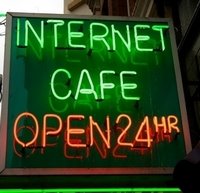
Travellers need internet cafes

PING! Email newsletter arrives from trendy guidebook giant Lonely Planet with news on some research they’ve carried out with Mintel.

Apparently 95% of young travellers say a camera is the most important piece of technology on the road. No surprise there, of course.

A close second, however, is the internet cafĂ©. So all-encompassing has the web become in the lives of travellers that they can’t do without it.

Interestingly the mobile phone (you never know when you’ll need one in the jungle) was further down the list, with over a third saying they did not feel it was an important item.

So what did travellers say is the most enjoyable part of travelling? Most said “exploring other cultures”, “interacting with locals” came high on the list, and the dreaded “finding myself” also featured strongly.

Kevin May, editor, Travolution