New Skyscanner site in Beta
Check it out the new Skyscanner website. Explanation of features.

Results page:

Route map:

Busy week in meta search land.
Kevin May, editor, Travolution
Technorati tags: skyscanner

Check it out the new Skyscanner website. Explanation of features.
Google’s travel leader for France, Enrique Nalda, unveiled some conversion rate figures, claiming that the stats were not a secret.
So no reason for us not to repeat them.
General conversion rates from Google for OTAs is 1-5%; airlines 5-10%; cars 10-15%. 'Immediate conversion’ – when a click is followed through to a booking without the user pausing for thought - is between 0.5% and 2.5% for OTAs.
Fellow panellist Bo Jensen, Kelkoo’s country manager for Denmark, kept quiet, although he was nodding in agreement when Nalda said that the conversion rates from search and vertical search was ‘better than affiliates, display advertising or newsletters’.
Clearly the biggest story kicking about today concerns Microsoft's "audacious" (or so says the MediaGuardian, which loves the hyperbole of it all) bid for Yahoo!.
Microhoo or YaSoft? Both sound rubbish.
A letter to the Yahoo! board last night proposed a £22.4 billion takeover of the company.
The Silicon Valley blogs are going crazy with excitement. [Excellent coverage of a Microsoft conference call]
From a search point of view you can see why the Americans can hardly contain themselves.
Yahoo share coupled with Microsoft's is around 33% of the market (Comscore), against Google's 58%, meaning it would certainly have a decent challenger in the US if the two combined.
In the UK, however, it would be a different story. Google currently commands between a 75% and 80% share of the market, depending on which measurement you use.
Nevertheless it completely dominates the search market here.
From a travel perspective I would hazard a guess that a takeover would hardly send digital marketers skipping happily into balmy sunset.
Almost everyone we have talked to in the past year or so has spoken admirably of Panama (YSM's search platform) and Microsoft's AdCenter - "but without the volumes there is not much point".
Where this proposed takeover might make a difference is in the area of portals.
Yahoo has a sizeable travel portal (and there's always Kelkoo!). Microsoft has the Live network.
Search plays a part in the all this, but I wonder if the takeover is more of a way of reaching consumers with other services.
Kevin May, editor, Travolution
Technorati tags: yahoo microsoft google
 The Financial Times today reports Yahoo! is considering its options over price comparison site Kelkoo.
[Full report here - will need subscription in a few days]
This is a bit of a funny one as, in terms of travel, Kelkoo almost feels like the outsider these days.
Talk to anyone in the travel search/price comparison arena and Kelkoo barely warrants a mention.
There is always plenty of back-slapping between the likes of TravelSupermarket, Kayak, Sidestep, Skyscanner, even Cheapflights - but when was the last time anyone heard Kelkoo mentioned in the same breath.
Mind you, it has managed to achieve the Holy Grail of travel search: apparently securing a relationship with Expedia, although Travelsupermarket works with on some car hire products.
One suspects this story is going to develop...
Kevin May, editor, Travolution
Technorati tags: kelkoo yahoo meta search price comparison
 At a recent Travolution advisory board meeting, Clive Peoples, head of customer communications for Expedia UK, was brutally honest about how the company
 rather dislikes views some meta search engines.
There are a lot of companies out there that will spend a lot of money just on advertising just to generate traffic and get bought by another company – and they are not long-term models. I have no interest in helping them do that.Ooh, ouch.
In the US there is work we’re doing with Kayak and other companies, but there’s just an awful lot of companies launching and we’re not looking to channel any of our profits into their back accounts to help build them up.
We’ve got a very large brand, which is very good for us as we get a lot of traffic directly.We think this is rather fascinating stuff from Expedia and goes to the heart of the meta search-online travel agency issue.
Not being present on TravelSupermarket does not cause us any problems at the moment, because what we are seeing is that people are going to TravelSupermarket and are coming to us anyway as well.
It’s going to be good traffic because it’s been refined, been through a filtering mechanism, so if it can be acquired at the right price and as long as they can convert it into a booking, then it actually makes sense for OTAs and suppliers to take part in it.The problem exists in other parts of the industry, where business types are still struggling to find ways to work together.
Travel search engine Henoo.com has been getting a fair bit of attention recently, mostly for the launch of its car hire search engine (last week) and revamped holiday search tool (yesterday).
But what the Internet Business Group-owned website hasn't anounced officially is that the site has also quietly started testing its flight search section. Chief executive Maziar Darvish hinted during an interview with Travolution in December that the site would be adding flight search at some point in the New Year.
So, with little fanfare, here it is...
Kevin May, editor, Travolution
Today’s confirmation of job cuts and a massive restructuring at online travel agent Opodo will not surprise many in the industry. The agency has seen a string of senior managers leave in the past few weeks following the arrival of new chief executive Ignacio Martos (pictured) from Spanish travel portal Rumbo. [He was brought in by parent company Amadeus to replace Hilton-bound Simon Vincent]
The exit list includes: HR director Garry Thompson, chief financial officer Jill Robinson, UK country manager Neil Mott, commercial and product director Sally Balcombe, and head of tours Chris Roe.
Rumours have been circulating all week after it emerged Roe had quit to join Virgin Holidays, with speculation suggesting a redundancy headcount of 70 (neither confirmed or denied) and a fundamental shift in its operations from a highly centralised business to what will now be very much a regional operation.
Ever since the company was first mooted by a group of nine European airlines in late-2000, chief executives (one for every year since its launch in 2001, in fact) have had to face not only the rapid rise of their rivals Expedia and Lastminute.com, but the growth of supplier-direct websites.
Indeed, Ebookers is looking to re-enter the fray, after a few years in the doldrums, with a vastly improved technology platform and new look website (expected in April).
However there is no doubt that there is some pressure on the old – we can call them that now – OTAs as airlines and hotels beef up their websites and the travel search engines, such as Travelsupermarket, Sidestep, Kelkoo, Cheapflights, Kayak et al, continue their speedy growth.
Opodo’s new strategy will be to create localised management teams, responsible for their own marketing and commercial operations, enabling them to react quickly to regional trends.
This makes sense in many respects – Opodo has different rivals and fundamentally different challenges in each market. [Expedia is strong in the UK, but less so in France, while for Opodo it is the opposite scenario]
Clearly Opodo needs to be well positioned and shaken up in order to grow or indeed, as some suggest, survive.
Kevin May, editor, Travolution
Look across to the right hand navigation bar and you’ll see a new function – a vertical travel search engine powered by Google.
Or, Troogle, as some of us have been calling it for a few months now. [“Obsessed”, is how one senior Google figure jokingly, we hope, described us today!]
In typical Google fashion, however, it is actually rather simpler than just being a travel vertical search engine.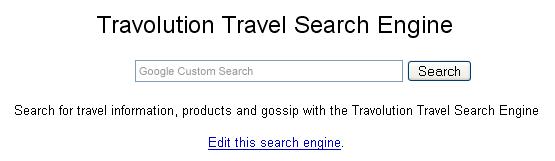 Google Co-Op, the official title, is a service (in beta) that allows users to create their own engine and dictate which websites to search.
We have therefore created the Travolution Travel Search Engine, and embedded it into the Blog.
At the moment it searches around 20 different websites, including Lastminute.com, Expedia, Travelsupermarket, Kelkoo, Thomson, BA, Ebookers et al.
The significance of this cannot be underestimated. This is essentially a customised search engine that allows users to only search for products in websites of their own choosing – in our case, travel-related sites.
"Google Co-op was built to be scalable enough to cover a wide array of topics," says our Google friend.
"Our goal is not to focus on particular verticals. Instead, we’ve tried to create a system that can make information more discoverable across all topics.
"We want to point people to the most relevant and useful information on the web, not keep them on Google."
Let the debate begin...
Kevin May, editor, Travolution

