Thursday, August 31, 2006

Ryanair has mobility in its sights

Ryanair is struggling to stay out of the news at the moment – and the latest Daily No-Frills Industry Update sees the carrier unveiling a plan to allow mobile calls on some of its aircraft.

Mobile and Blackberry-wielding passengers will be able to send texts, emails and chat if they are travelling on one of Ryanair’s fleet of Boeing 737s.

Of course there will be a small fee for the privilege – OnAir, the company behind the technology, will charge users a “rate which will mirror international roaming charges”.

The first 50 aircraft will be fitted with the technology by the middle of 2007, with the remainder of Ryanair’s fleet online from early 2008 onwards.

In a press release, Ryanair’s outspoken boss, Michael O’Leary, gushed that passengers “will be able to pass on the good news to workmates, friends and family that they are travelling on another on-time flight with Europe’s most punctual airline”.

Quite.

Luckily for Ryanair the Department of Transport in the UK has since removed the ban on mobile phones in hand luggage, following the alleged plots to blow up aircraft on trans-Atlantic routes.

[Ryanair and its Churchillian approach to terror]

Kevin May, editor, Travolution

Wednesday, August 30, 2006

Geo-mapping on Flickr

Flickr, the Yahoo!-owned online photo sharing service, has upped the game somewhat in the increasingly competitive sector by launching a mapping feature this week.

Travolution expresses an interest here after showering the tool with praise earlier this year when we used it to host pictures from the Travolution Summit in April and our Travolution@ITT adventure in Oman.

Unveiled rather quietly yesterday on the Flickr Blog, users can now “geo-tag” their pictures on Yahoo! Maps.

When a visitor to a slideshow wants to see where a particular picture or set of images were taken they can now click on the Map function and, voila, a reasonably detailed map appears with an embedded Flickr showreel.

Kevin May, editor, Travolution

Speed is of the essence

Gail Kenny from Gail Kenny Executive Search writes:

2006 has been a fantastic year for job seekers looking for online roles, but at the cost of employers. Candidate Power!

That's how I would describe the way that the scales are currently tipped in the online travel recruitment sector.

It is not uncommon for demand to outweigh supply or vice versa, but I have never seen it at this time of year, during the supposed summer recess.

Quality candidates with good online skills are a sought after resource, and yet employers are missing some of the best ones by not moving quickly enough.

While decision makers are away, decisions aren't made and some of these top candidates are being snapped up by those who are more agile, and in some cases are leaving the travel sector.

Those companies that can react quickly and get an offer on the table will beat their counteroffers by being the first to make a decision.

I have seen two cases this month where the travel industry has lost two exceptional online marketers to companies outside of travel - The Body Shop and Monster – mainly down to painstakingly slow processes.

I predict the demand to continue well into 2007, so pressure needs to be put on employers to make quick decisions – after all this is supposed to be a fast moving sector!

Gail Kenny, managing director, Gail Kenny Executive Search

Tuesday, August 29, 2006

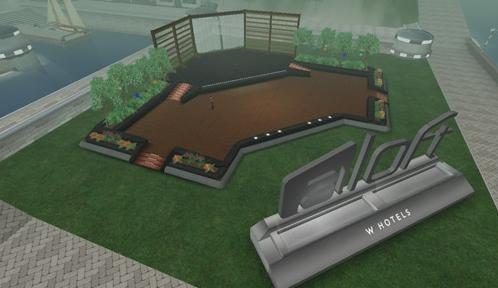
Latest on Aloft hotels in Second Life

We recently highlighted the Second Life experiment – a series of virtual worlds being built by some seriously clever people in the US.

Starwood Hotels has partnered with the creators to build one of its hotels within the system, ahead of a “real” hotel being constructed in a few years time.

It’s a fascinating project.

Recent events have included putting the finishing touches to the exterior of the hotel and its surroundings – a rather nice island, in fact – before heading inside to install everything else a hotel might need.

Perhaps the most bizarre recollections on the creator’s blog – and one that will perhaps reinforce opinions of those critical of the “virtual world” experience and its effects on people – comes in the form of a promotional photoshoot for a magazine.

More updates here in the coming weeks, ahead of the hotel’s grand opening in September

Kevin May, editor, Travolution

Friday, August 25, 2006

Taste of the search engines for Milburn

So what do ex-government ministers in the UK do during the Silly Season, in order to pass the time?

Well, if you’re Alan Milburn, former-health minister and now MP for Darlington in the north of England, you spend lots of time with your family (because that’s why he resigned in the first place, of course) and you get involved in travel search.

Really?

Donning his “community business” hat this week, Milburn was on hand to help launch Travelsearcher, a free-form text search tool, created by local company Geo-Net.

The other chap in the photograph is managing director Peter Bulloch, and it was taken at Geo-Net’s offices, not a villa in Tuscany or Cliff Richard's Caribbean home - popular destinations amongst New Labour politicians.

[Read our exclusive story Internet users changing search habits on Travolution, featuring some research carried out by Bulloch and his team]

Kevin May, editor, Travolution
Thursday, August 24, 2006

The first rule of (Google)Fight Club is…

Fancy a bit of fun over a tea break, then Googlefight is the answer.

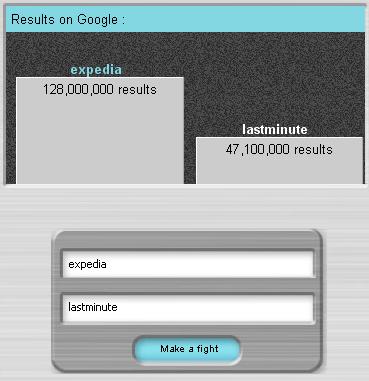
It’s actually a frighteningly simple website that uses rather silly animation to perform a little punch-up, demonstrating the amount of search results particular keywords gain on Google.com – all against the backdrop of a battle between arch rivals.

The site has a handful of what it calls Classic Fights, such as “God versus Satan”, “America versus Iraq”, and so on.

But for the travel sector the results are actually rather intriguing.

The results are based on keyword returns, rather than the popularity of websites, but, for example, “Expedia versus Lastminute”, Expedia comes out way on top with 126 million returns against 44.4 million for Lastminute.

So here are Travolution’s Classic (Travel) Fights:

Cheap flights versus Cheap hotels” = 55.8 million against 99.8 million

Spain holiday versus Greece holiday” = 37.3 million against 22.4 million

Paris weekend versus New York weekend” = 46.7 million against 148 million

Ebookers versus Opodo” = 7.6 million against 9.19 million

Find any better “fights”, let us know…

Enjoy!

Kevin May, editor, Travolution
Wednesday, August 23, 2006

PC TripAdvisor

Reports circulating today about TripAdvisor's new - unofficial - role as a good old fashioned police officer for the travel industry.

The Metropolitan Police website says two people have been charged following investigations into the activities of a holiday firm in London.

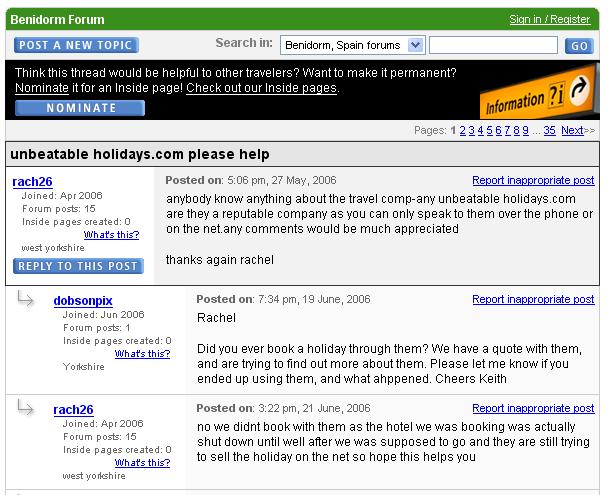
It turns out, according to reports, that the fraud squad was alerted to alleged problems with a Fleetwood Holiday Ltd and Sun Orient Ltd after seeing posts on TripAdvisor's forums.

The police have even gone so far to request information from any consumers that have booked holidays on the following websites: Sunmedresorts.com, Unbeatableholidays.com, Holidaysforunder200pounds.com, Holidayrez.com and Holidayez.com.

According to some of the forum posts, the Daily Express, GMTV and Meridian TV have already run stories on the supposed scam.

It is also understood that the Association of British Travel Agents has been working with police for quite a few months, since concerns were raised by consumers.

[Get the Met Police's feedback form]

Kevin May, editor, Travolution

Sky viewers learn about blogging

For fear of creating an unofficial Hitwise Day on the Travolution Blog, here’s actually an interesting clip of Heather Hopkins on Sky News this week, talking about Blogs.

[Shame she didn't mention the Travolution Blog - Ed]


Kevin May, editor, Travolution

Australia searches illustrate buoyancy in travel

Heather Hopkins at Hitwise UK writes:

In one of the busiest months for holiday makers, the travel industry was hit hard by an averted terrorist plot, stories and images of queues at the major airports, and now threats of a strike at Stansted this coming bank holiday weekend. [Since cancelled - Ed]

We prepared a brief analysis of the impact of these events on consumer behaviour online to help our customers understand the impact on the industry and to benchmark the impact on their own.

Overall our analysis reveals that fewer visits are going to travel websites, with the exception of websites for airlines, which consumers are likely contacting for updated travel information. The analysis also reveals that long-term travel plans, such as plans to visit Australia for the Ashes Tour, do not appear to be impacted.

Last week I posted on the immediate aftermath and so will focus today on the results in the week after the attacks.

The following chart illustrates the share of all UK internet searches for the ten most searched-for destinations (measured as searches that include the keywords "flights to") in the past four weeks.

Whilst searches for many popular destinations declined last week, searches for "flights to australia", "flights to tenerife", and "flights to turkey" all increased. Searches for "flights to Australia" were no doubt buoyed by the cricket matches over the weekend and anticipation of the Ashes tour.

New York was hard hit, with searches for "flights to new york" moving from position 5 among the most searched-for flight destinations to position 10. Searches for "flights to new york" also experienced the largest week-on-week decline in share of searches, down 56% week-on-week and 4% year-on-year.

Visits to travel websites declined last week but it is important for travel companies to be able to benchmark their own decline against the industry to understand if they are fairing better or worse - or the same - as competitors.

The following figures provide the percentage change in market share of visits to travel category websites comparing the week ending 5th August 2006 with the week ending 19th August 2006.

Since visits increased to travel websites in the immediate aftermath of the security alert, the comparison is done to the week before to provide a more accurate measure of change.

Travel – agencies: -17%

Travel – destinations & accommodation: -10%

Travel – transport: +9%

Aviation – commercial airlines: +19%

The top 10 sites in the travel agencies and destinations & accommodation categories all experienced a decline in market share last week compared with two weeks prior. Transport site visits varied, with some experiencing growth and others declines.

Thomson Fly, BMI Baby and Flybe all saw their market share of visits decline over the past two weeks, by 10%, 5% and 14% respectively.

British Airways, RyanAir and BAA all saw the highest percentage growth among the top ten, at 17%, 13%, and 203% respectively.

The top 10 sites in each of the travel categories for the most part remained unchanged last week. The only notable exception was that British Airways took the #2 ranking among commercial airlines, overtaking RyanAir by a margin of less than 1% market share of visits.

Heather Hopkins, vice president for research at Hitwise UK

Read more from Heather’s blog

Tuesday, August 22, 2006

PS: Your Cat Is Dead

Tim Walters at Fatwire writes:

No need to call the RSPCA: the title comes from a novel (later a play and a film) written by James Kirkwood.

It’s also a reference to my March 27 blog entry on the similarity between faithful kittens and loyal travel consumers. I claimed that contrary to the widespread view that the internet undermines customer loyalty, “the wealth of information about options and alternatives easily available on the web in effect makes genuine customer loyalty possible for the first time”.

But according to a presentation by Forrester Research travel industry analyst Henry H. Harteveldt, this claim is somewhere between half-right and quaintly obsolete. In an April webinar with the great title – It Doesn’t Have To Suck: Making Web Travel Planning Better – Harteveldt and Suzanne Cook argued that loyalty should no longer be understood as “owning” a customer (like the cat that returns faithfully to your porch every morning).

One of the reasons they gave is that the “abundances of choices” – awareness of which is magnified by the internet – “makes loyalty unnecessary” and further denigrates the value customers place on being loyal to a supplier.

The time and money invested in travel industry “loyalty programs” is, in this view, usually aimed at the wrong target. The real goal is not loyalty but advocacy – not a customer who will (perhaps, but don’t count on it) return to your brand or service but rather one that will actively recommend and promote your products to a potentially huge (because ever expanding) community of future customers.

Loyalty – if that’s what it should still be called – is effectively an exercise in viral marketing. Except that instead of unemployed actors praising the latest banana flavored vodka in a crowded bar, this viral marketing is genuine.

It’s also likely to be directed at friends or colleagues – and therefore more likely to be accepted as trustworthy and more likely to compel action.

So far, so obvious – everybody knows that it’s a good idea to have happy customers. (And yet so many don’t do enough to deserve them – witness Neil Stiles’ Devon experience)

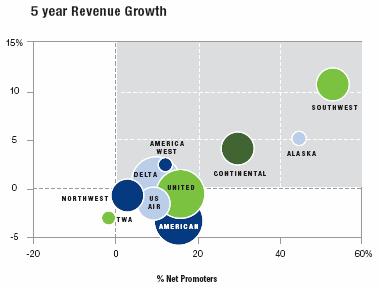
But it turns out that the stakes are much higher than just achieving positive “word of mouth.” Satmetrix and loyalty guru Frederick Reichheld of Bain & Company have developed the notion of a “Net Promoter” ranking – basically the percentage of promoters minus the percentage of detractors in a given customer community.

As this graph from the Satmetrix website shows, there can be a remarkable correlation between the Net Promoter score and business growth.

In short, loyalty is not so much about your customers as about your future would-be customers. (Thus Reichheld’s related notion of how the “bad profits” obtained from today’s disaffected customers undermine tomorrow’s success)

A loyalty program isn’t (or shouldn’t be) about trying to retain what you have – it’s about creating an environment in which you can gain what you don’t yet have – and then ensuring that this future comes into being. Which, as it happens, is not far from Immanuel Kant’s definition of a promise.

PS: If you did call the RSPCA, they’d likely send out a field rep with the help of their FatWire-based web content and knowledge management system.

PPS: John Simon’s review of the one New York production of “PS: Your Cat Is Dead” carried the title, “PPS: So Is Your Play”.

[That's enough PSs - Ed]

Tim Walters, director international marketing and strategy, FatWire Software

Monday, August 21, 2006

Boeing - service cannot connect

So farewell, Boeing Broadband, after a frenetic few years of signing up various airlines to try out the aircraft manufacturer’s online access system, bosses have now decided to pull the plug instead.

Connexions by Boeing, as the offshoot was officially known, was first muted in April 2000 and launched with great fanfare in May 2002.

Since then CbB had managed to woo Air China, China Airlines, Japan Airlines, Scandinavian Airlines, All Nippon Airways, El Al Airlines, Korean Air, Singapore Airlines, Asiana Airlines, Etihad Airways and Lufthansa into use the service.

Alas, Boeing released a short statement last week to announce it would be axing the business.

"Over the last six years, we have invested substantial time, resources and technology in Connexion by Boeing," said Boeing chairman, president and chief executive Jim McNerney. "Regrettably, the market for this service has not materialised as had been expected.”

This is somewhat of an understatement: Boeing said that just simply shutting down the service will cost around £170m.

Some reports suggest airlines and consumers alike were more impressed with cellular internet networks, which were more reliable and cheaper.

Kevin May, editor, Travolution
Friday, August 18, 2006

A modest man, who has much to be modest about

Hectic week for Ryanair – in more ways than one.

Having the government stick a knife into its business model – no hand luggage, massive pressure, because of security, on its notoriously quick turnarounds – hasn’t helped matters.

So what does Michael O’Leary and Co have to do in order to get back on track (that should probably read: take off again)?

Well, threatening to sue the government is always a sure sign that a business is rather hacked off with the situation.

But if and when the current security measures are relaxed you can bet a flight to Charleroi that the government will never admit this was because of pressure from the airline industry.

Meanwhile, with typical gusto, Ryanair.com has this week also unveiled a marketing drive to sell one million air tickets, via its website, for £25 each way.

And who features in the press campaign [picture from the Daily Telegraph]? It’s Winston Churchill, of course, pictured in a fight-them-on-the-beaches-type pose, titled “Let’s Beat Terrorism – Keep Britain Flying!”

Consumers and the industry alike may love or hate Ryanair boss O’Leary, but his canny marketing people sure know how to create a press campaign in order to try and capture the moment.

[Not sure if they using the same ad in the Irish press!]

Kevin May, editor, Travolution

Thursday, August 17, 2006

Is Hoberman onto something else?

Nobody expected Lastminute.com co-founder Brent Hoberman to stay quiet for too long, following his decision to stand down as chief executive of the now Sabre-owned online travel agent to become part-time chairman.

Energies have now been diverted into helping set up – as a non-executive director – Univillage.com, a new community website for students.

Today’s announcement by site’s founders, Henry Yates and ex-boss of youth marketing agency, Face, Andrew Needham, coincides rather handily with the UK’s A Level results.

The site will integrate social networking tools such as Yahoo! Messenger as well as allowing hard-up students to download music or find a local club.

“You can now decide who you fancy, who to avoid, make friends and even decide what clubs to join before you even arrive,” says Yates. “Tomorrow [launch day, 17 August] signals the death of Freshers’ Week as we know it.”

Yates told us earlier today that, despite the presence of Hoberman in the company, there are no immediate plans to launch any travel functionality.

Only a matter of time, surely…

Kevin May, editor, Travolution

Work harder, faster and smarter

Neil Stiles, managing director of Travolution, Travel Weekly and other titles at Reed Business Information, writes:

Having just returned from a somewhat disappointing weekend to north Devon I was struck by the lesson for all of us as the world we inhabit changes at an exponential rate.

What should one do in the face of change? Well first what are ones choices?

1) Resolutely stick to what you know, do nothing different and, effectively, enter the denial zone, is clearly a popular one; 2) don't change - it will pass as a close relative of 1); or 3) become increasingly resentful of the customers who want the new things and treat them badly (a popular one); and, I guess, an old favourite: 4) up-price, down-service and hope to hell you can ride it through ‘til you retire and screw those coming up behind you.

Clearly none of the above are viable solutions, not that you would know this from a quick check around the UK travel agent and tour operator business, or for that matter a guest house in Devon.

However it is easy to say what not to do, but somewhat harder to pin down a promising action plan to evolve.

On checking a few academic websites, and referring to some tried and tested change manuals, as well as the experience of my own business (media), which is in the midst of massive change, it seems the only real strategy is to work harder, faster and smarter.

Yes, it is probably as simple as that, or in a few words: give customers more.

Clearly not something that the Devon guest house I stayed in was sure about.

Neil Stiles, managing director at Reed Business Information

Neil visited the Holiday Watchdog website to post a review of his stay in Devon.

Wednesday, August 16, 2006

How do I work this text thing, Daddy?

PING! Email arrives from Virgin Atlantic boasting about a new Q&A service it has introduced on all its flights.

Apparently passengers will be able to text a question via their in-flight entertainment systems and get an response “within minutes”.

Interesting stuff. The service has been developed by Any Questions Answered, a UK-based company that has been running an SMS-based system for a few years and has already answered three million text questions.

The press release says the top-five flight-related questions are:

“What terminal do I need to go to?”

“Has the plane landed yet?” [Surely even the least sober of passengers would know the answer to this!?! – Ed]

“How long is the flight?”

“What hotels can you recommend?”

“How do I chat up someone in…?”

Kevin May, editor, Travolution

Thanks for voting

To celebrate the end of our online poll to find The Influential Ten – the innovators and pioneers of the last decade in online travel – we’ve decided to give away a bottle of champagne to a lucky voter.

Jason Stockwood, managing director EMEA for Travelocity Business in Buckinghamshire, was randomly selected from a list of email addresses

[The winner was not picked by us in the Travolution office but by the IT people elsewhere in Reed Towers, so – before readers ask – we do not know who Jason voted for and did not have any influence over who should win the bubbly!]

Many thanks from the Travolution team to all who voted. Look out for the results in the September edition of the magazine.

Kevin May, editor, Travolution

Tuesday, August 15, 2006

Cool websites - according to Time

Everyone on holiday? Editorial no-brainers? Nothing else going on in the world?

Well, probably not the last one, but it does seem like everyone is falling over themselves to produce lists of “best ever websites” and the like at the moment.

Today’s offering comes courtesy of Time magazine in the US, which has produced a list of the 50 Coolest Websites.

"Many of this year's choices are shining examples of Web 2.0: next-generation sites offering dynamic new ways to inform and entertain, sites with cutting-edge tools to create, consume, share or discuss all manners of media, from blog posts to video clips," says the producer of the piece, Maryanne Murray Buechner.

So here are the five sites it selected from the travel sector:

* Meta search site Kayak

* Hotel and restaurant review site Yelp

* Car-sharing site Zipcar

* Airfare prediction site Farecast

* Public transport site Hopstop

Times has also picked a handful of search engines: Accoona (so-called artificial intelligence site) and Snap (apparently a serious competitor to Google).

Kevin May, editor, Travolution

1,000 and counting

In July we revealed how travel agent information provider Gazetteers Plus was introducing “user-generated content” to its trade website.

[Original post]

It appears the enthusiasm by agents for penning a review of a destination or resort has been rather good, with over 1,000 submitted in just three weeks.

Of course we have to declare an interest here – Gazetteers Plus is part of Travolution parent company Reed Business Information – but the initiative shows that Web 2.0 tools such as user-generated content are equally popular within the trade as well as with consumers.

What is interesting here is that Gazetteers Plus is not used exclusively by one particular travel provider – around 60% of all UK travel agents use the service – and therefore agents are happily sharing knowledge between rival agencies.

You can almost feel the love spreading through the trade…

Kevin May, editor, Travolution

Monday, August 14, 2006

Well done to EasyJet

Low-cost airline EasyJet has made it onto a list of "Websites That Changed The World".

Others on the rather dramatic sounding list include YouTube, MySpace, Ebay, Google, FriendsReunited and Napster.

See the full list.

Nice to see that the producers of the piece, The Observer, are bashful enough not to have include their very own Guardian Unlimited - a website that, most people agree, has pushed digital publishing into the new age.

Kevin May, editor, Travolution

State of the Nation - update

Some of you – including all Travel Weekly and Travolution readers – will have recently received an invitation to take part in a survey for our September edition.

The particular piece of research you have been contacted about is just one strand of our State of the Nation report – a wide-ranging study into the current online travel market.

Response to the trade survey has so far been excellent, so therefore we would like to offer it out to users of the blog.

You can take part in the survey [it takes just 5 minutes], but, be warned: we are evaluating the results this week, so the survey will be closing at the end of play on Tuesday 15 August.

The other surveys have been completed by Metro newspaper and Lorien Research.

Thanks, in advance.

Kevin May, editor, Travolution
Friday, August 11, 2006

Traffic to travel sites soars after alleged terror plot

Heather Hopkins at Hitwise UK writes:

Yesterday's announcement that Scotland Yard foiled a terror plot to blow up six transatlantic flights from London sent chills through the UK as the terror alert was raised to the highest level.

Flights were cancelled; security screenings tightened; and airports were in chaos.

We looked at Hitwise daily data from yesterday to see where consumers turned for information.

* Share of UK visits to BBC News were up 50% yesterday and the site became the 9th most visited internet site, up from 14th the previous day.

* The British Airport Authority (BAA) was a top destination for information, with share of UK visits to BAA's website up 8 fold (see chart below). The site became the 64th most visited website in the UK, up from 544th on Tuesday, marking the site's highest daily rank in the past 12 months by almost 300 places.

* Websites for the UK's two biggest airports, Heathrow and Gatwick, also saw a dramatic surge: Gatwick Airport became the 21st most visited travel site and Heathow Airport increased more than 200 positions to rank as the 23rd most visited travel site.

* Share of visits to the aviation category were up 79%, with the websites for EasyJet, Ryanair and British Airways all experiencing a significant increase in share of UK visits (48%, 76% and 61% respectively).

* Share of visits to travel agencies were down 19% yesterday, indicating that consumers were contacting airlines directly for updates on delays and cancellations.

* UK consumers also appeared to be looking for alternative travel arrangements with share of visits to Eurostar up 56% and share of visits to Direct Ferries up 38%.

* Share of visits to news sites were almost on a par with July 7th last year, the day of the London bombings, accounting for 5.26% of all UK internet visits and up 18% from the previous day. The news sites for the BBC, Yahoo!, Google, MSN and Sky were all up yesterday.

* With the terror alert elevated to "critical" the websites for MI5 and the Home Office were also popular sources for updates yesterday. MI5's website leapt in the daily rankings from 254 to 9th among Government sites and the Home Office site jumped from 75th to 10th. Visits to MI5's website rose 18 fold and visits to the Home Office website rose 6 fold.

Heather Hopkins, vice president for research at Hitwise UK

Read more from Heather on her Hitwise Blog

Ebookers comes clean on the Google issue

So Ebookers has responded and admitted that it has “big problems” with its search engine optimisation on Google.

This follows a flurry of activity in search engine circles earlier this week and here on the Travolution Blog [where we had a particularly passionate response from Mr Travel Rants, Darren Cronian]

This obviously comes as no surprise as users searching for the online agent on Google have been greeted with everything except Ebookers in recent weeks on search results for "ebookers".

What our exclusive interview with Ebookers revealed is that the Travelport-owned website has, in fact, been at the centre of an ongoing row with Google – with the Ebookers.com site actually de-listed by the search engine for three months earlier this year.

Ouch.

As widely predicted, the reason for all this mayhem is that Ebookers has been using a single IP address across its portfolio – including the dot-com and other country sites.

Google, as many will know, has a tendency to frown upon duplicate content on different sites that still use the same IP address – cue the rather swkward problems recently that have seen searches on the keyword “ebookers” place the official site at least half way down the second page of results.

Not only this, but angry consumer watchdog sites, such as Grumbletext, with some highly critical comments about Ebookers, have often been placed in second or third spot.

Double ouch.

The company’s e-marketing boss, Saurabh Kumar, seemed rather unconcerned about the whole issue [although only the foolish would be openly distraught about it to a member of the media, of course!].

Elsewhere, on the E-consultancy website, comments have been flying in about Ebookers "link bombing" itself.

As reported in our June edition, Ebookers owner, Travelport, is in the middle of a wide-ranging strategy to revamp all sites outside of the US, with Ebookers expected to see a major redesign and overhaul of its back-end.

This much-needed work, coupled with sorting out the IP address issue, will cure it of the problems currently being experienced on the Google platform – apparently.

Kevin May, editor, Travolution

Thursday, August 10, 2006

Last chance to vote for the Influential Ten

Our online poll to find the find the innovators and pioneers of the last decade in online travel closes tomorrow, Friday 11 August.

Make sure you cast your vote.

Here's the shortlist again:

Simon Breakwell (ex-Expedia Europe)

Sergy Brin and Larry Page (Google)

Pierre Chappaz and Dominique Vidal (Kelkoo)

Tony Cheng and Jim Donnelly (Igougo)

Dinesh Dhamija (ex-Ebookers)

Bob Diener and Dave Litman (Hotels.com)

Barry Diller (Interactive Corp)

David Filo and Jerry Yang (Yahoo!)

Bill Gates (Microsoft and Expedia)

Simon Talling-Smith (BA.com)

Stelios Haji-Ioannou (Easy Group)

John Hatt (Cheapflights)

Brent Hoberman and Martha Lane Fox (Lastminute.com)

Mark Jones (Online Travel Corporation)

Terry Jones (ex-Travelocity)

Steve Kaufer and Langley Steinert (TripAdvisor)

Michael O’Leary (Ryanair)

Andy Phillips and Adrian Critchlow (ex-Active Hotels)

Jay Walker (ex-Priceline)

Alex Zoghlin (ex-Orbitz)

The results of the poll will be produced in our landmark September edition of Travolution, where we will be celebrating ten years of online travel.

Kevin May, editor, Travolution

Stay at a virtual hotel

Here’s a smart gimmick/idea (call it what you want) created by US resort giant Starwood to promote a new development at its W Hotels chain.

W Hotels has signed up The Electric Sheep Company, a Washington-based developer that uses technology to “realise” construction projects, to produce a virtual world for its new cut-price Aloft hotels.

The first Aloft hotels will open in 2008, while there are also plans for another 500 more around the world by 2012.

So to build a little bit of momentum the company is adopting an unusual – if probably rather expensive – marketing strategy and has asked Electric Sheep to build a computer-generated model of a fictitious Aloft hotel, based on its Second Life model.

But this is not the usual, flashy 3D graphic model of rooms, bar area, swimming pool and marina.

Once the hotel is “open” to the public in September, users will be able to develop their own avatars – similar to the computer game, The Sims – and stay at the resort.

Each user will be able to walk around the complex – in this case a rather pleasant island – and interact with the hotel’s facilities and other guests.

An Electric Sheep-run blog is following construction of the virtual Aloft hotel every day, ahead of its official “opening” in September.

Kevin May, editor, Travolution

Wednesday, August 09, 2006

Savviness checker

Spatial-literacy.org has produced a paper that outlines 23 e-types of the population, based on access, usage and dependency on technology.

Interesting project - you can find out what type you fit by entering your postcode.

Some notes from the professor behind the project and a list of the catgeories are available.

[Travolution is in the group C category, "becoming engaged"]

Kevin May, editor, Travolution

Tuesday, August 08, 2006

Where is Ebookers on Google?

Travolution returns from a weekend away and a curious email arrives from the good folk at the Search Engine War blog, alerting us to some rather odd goings on at Ebookers.

It appears the online travel agent is having a few issues with its search engine optimisation.

If users type in Ebookers into Google, Ebookers does NOT even feature on the first page of natural search listings.

This is rather bizarre considering how optimised for organic search one would think a pleading online player would be.

They are, of course, paying for pay-per-click listing on the word “ebookers”, but a hard link into the website does not appear until the fifth entry on the second page.

Carbookers.com, the car hire section of the site, is in fact the top search result, but equally does land users on the homepage.

Rather embarrassingly for Ebookers, a consumer site called Grumble Text, with a string of nasty comments about the company, currently appears in second place.

The problem could be down to pagejacking, as Teddie Cowell at Search Engine War says in his post.

Chris Lake on E-consultancy has set the ball rolling on trying to discover what has happened.

Heather Hopkins at Hitwise UK chips in: “I looked back 8 weeks to the four weeks ending 3 June 2006, and at that time, Ebookers receiving 84% of visits from searches for its brand. This indicates to me that it is likely a result of the recent changes that Google made to the algorithm.”

Cowell adds: “Possibly as part of their duplicate detection, Google thinks that the main Ebookers.com website is now faulty so Big Daddy, which attempts to decide the most appropriate page to show, has defaulted to Carbookers.com instead.”

UPDATE: We have now managed to talk to Ebookers and will be running an update on the Travolution website and here on the blog on Friday 11 August.

Kevin May, editor, Travolution

Friday, August 04, 2006

Reality is a virtual certainty

Darren Cronian at the Travel Rants blog got in touch earlier this week to point us in the direction of some technology being developed by Microsoft.

The computer giant’s Live Labs (Oh to have their R&D budget – Ed) have been playing around with a new gizmo called Photosynth, a three-dimensional way of linking images from the web to create virtual tours of cities or attractions.

Once fully developed, the system will allow users to “walk or fly” through a destination from any angle; zoom in and out of locations; and carry out customised tours.

The production values [demo here, with a walk through by one of the developers] are frighteningly high, although the Microsoft computers are clearly rendering the images at a far higher speed than your average home computer with a 1mb broadband connection.

“We are going to see a collision of the real world and the virtual world that will create this incredible experience that people can go and visit and get a sense of things they’ve never really seen before,” says principal researcher Rick Szeliski.

Right, back to flicking through that brochure I picked up earlier…

Kevin May, editor, Travolution

Thursday, August 03, 2006

Edinburgh Festival drives travel searches

Heather Hopkins at Hitwise UK writes:

With the Edinburgh Fringe Festival kicking off on Sunday, the Edinburgh International Festival starting Sunday week and the Edinburgh Military Tattoo kicking off Friday, travel related searches for Edinburgh have taken off.

Two weeks ago, searches for "edinburgh festival" shot up to become the top search query to contain the keyword "edinburgh", overtaking searches for "edinburgh airport" which typically tops the list.

Share of UK searches for "edinburgh festival" are up 60% compared with two weeks ago; "edinburgh hotels" are up 248%; "hotels in edinburgh" are up 86%; and "cheap flights to edinburgh" are up 146%.

Despite being overtaken by "edinburgh festival", searches for "edinburgh airport" are also up, 31% compared with two weeks ago.

Searches for "edinburgh festival" send visits to the official sites for the Edinburgh International and Fringe Festivals as indicated in the following table:

Eif.co.uk – 54.53%
Edfringe.com – 21.16%
Edinburgh-festivals.com – 4.9%
Edinburghguide.com – 1.96%
Theatrebreaks.com – 1.79%
Scotsman.com – 1.63%
Edinburghfestivals.co.uk – 1.36%
Wikipedia.org – 0.98%
Edlets.com – 0.98%
Edfilmfest.org.uk – 0.98%

Last week, the Edinburgh Fringe Festival website received more than 2.5 times more visits than the Edinburgh International Festival website, which received slightly less traffic than the website for the Edinburgh Military Tattoo.

The top downstream sites from the Edinburgh Fringe Festival website last week were for venues, including the Gilded Balloon, Pleasance Edinburgh, and Traverse.

Also among the top downstream sites were several travel sites, with 8% of the sites downstream visits going to travel sites last week.

The most prominent were accommodation sites, which are linked to from the Fringe Festival website, including Active Hotels, Ed Lets and Late Rooms.

Active Hotels is not only depending on the partnership with the Fringe Festival website to drive hotel business in Edinburgh, the site is also among the top recipients of visits from searches for "edinburgh hotels".

In the past four weeks, Active Reservations, Active Hotels' reservation site, was the number 2 recipient of visits from searches for "edinburgh hotel" after Hotel Direct.

Active Hotels has effectively diversified its online marketing to receive visits not only from the relatively expensive term "edinburgh hotels" but also from a partnership with the festival's website.

Such partnerships can be an effective way to reduce customer acquisition costs and maximise ROI.

Heather Hopkins, vice president for research, Hitwise UK

Read more from Heather on her Hitwise blog

Wednesday, August 02, 2006

The meaning of life - packing!

PING! Email arrives revealing the latest cutting edge research from online travel giant Lastminute.com.

It appears travel director John Bevan and co have been busy discovering crucial information about the personalities of consumers, based on the way they pack for their jaunts around the globe.

“Packing for your holiday is now just as important as choosing the right location, judging by our findings,” says Bevan.

“This knowledge can be used to work out whether you are in good company, especially if it’s with people you’ve never been away with before.”

Urging people to “think twice about what they pack for their trip to avoid sending out the wrong messages”, Lastminute.com has outlined six Packing Profiles in conjunction with ITV1's Love Island psychologist, Honey Langcaster-James:

The Kitchen-Sink Packer: Anxious, cautious, worrier, control freak, considerate (maybe needy)

The Minimalist: Laid back, down-to-earth, chilled, confident, self-assured, calm, relaxed

The Planner: Reliable, steadfast, self-controlled, perfectionist, committed, predictable, controlling

The SAS Survivalist: Adventurous, authoritative, responsible, serious

The Last Minute Packer: Fun, challenging, young-at-heart, unreliable

The Diva: Glamorous, flirtatious, choosy, high-maintenance, possibly anxious and insecure

Interesting – but unfortunately Bevan has not revealed his own Packer Profile or that of other leading figures in the Lastminute.com empire. Shame!

Kevin May, editor, Travolution

Can copy be too much of a good thing?

Toby Kesterton at LeadGenerators writes:

These days, most sensible online marketers are fully paid-up members of the Keyword Enhanced Copy (KEC) fan club.

When done correctly, KEC works as well for search engines indexing sites as it does for humans needing reassurance that they have come to the right place. Provided the text is well-written enough to please people reading your page; what’s not to like?

Today I’m looking closely at how much Keyword Enriched Copy you should write for your site.

I’m interested in two points in particular: firstly whether you should write a small amount of pages that are highly optimised for search engines or a lot of text that is perhaps not so highly optimised; and secondly whether you should put up a lot of text at once or put up a smaller amount of text every month and incrementally build up the number of pages.

The optimum would of course be to write a lot of pages of well-enhanced copy, but if this is not possible (remember that researching and writing KEC can be a very time-consuming process) I think it’s better to err on the side of writing fewer pages that are better enhanced.

The mass of pages that were not written incorporating much KEC would rate in the search engines to some extent, but on a fairly random, scattershot basis.

Properly optimised and targeted pages pay off in the long run, and over time you would be able to write new pages for the desired topics.

Rising from this is the question of how long each article should be. Which is the better tactic; to outsource the work to an external copywriter to write short pieces or to get expert staff to write longer essays?

An external copywriter is experienced and can write in a search engine friendly style, but would have to learn about the particular topic to write good text, whereas company staff can write about the subject easily enough but have plenty of time pressure.

Let’s move on to the important question of how often to add new content. Search engines like to see evidence that a site is constantly adding new content.

The theory goes that if you add new pages or new content every month, then this shows the search engines that your site is still a going concern, and they will consequently be prepared to rank you higher, as they estimate that your chances of providing the solution to a particular search are high.

The danger of putting up 60 new pages every six months as opposed to ten new pages every month is that the engines will look very favourably on your first update- but then register the lack of new content and downgrade your site.

We know that search engines prefer a natural content growth but does anyone have experience at putting up too much new content? Has this tripped any filters for any readers? Please get in touch if you have any thoughts on the matter – we’d love to hear your views.

Toby Kesterton, head of search engine optimisation, LeadGenerators

Tuesday, August 01, 2006

Blue skies

Expedia.co.uk clearly knows how to grab a bit of publicity, demonstrated recently with a page three splash in Metro about its “survey” to find the World’s Best Blue Sky.

Running to coincide with the company’s Let Yourself Go ad campaign, a TV researcher from Glasgow, Anya Hohnbaum, won an online competition against 2,000 other hopefuls to whizz around the world for two months testing the quality of the globe’s blue skies.

[Why Expedia didn’t come to Travolution for this arduous but highly scientific task, we’ll never know – Ed]

Measuring colour, clarity, brightness, cloud density and “mood”, Hohnbaum judged the skies above Rio de Janeiro to take the accolade of the world’s best blue sky.

Hohnbaum kept a journal of the trip, but failed to mention why she didn’t visit Travolution Towers in Sutton, Surrey, where – as our photo indicates – the sun always shines (apparently).

Kevin May, editor, Travolution