Friday, June 30, 2006

Top tips to avoid falling foul of the Google police

Ouch! The Daily Telegraph sent at least one company into a bit of a tizz this week when it published a damning article about the “new industry” of search engine optimisation.

The Daily Telegraph said the internet had “blown away the rules of the game”, except one: “If it sounds too good to be true, then it probably is.”

It then told the story of a UK company - The Search Company - which found an SEO specialist on an internet message board, who managed to suddenly send the company into the higher reaches of search results on the likes of Google.

Unfortunately – surprise, surprise – the company came back from a Christmas break to find the Google police had blacklisted its URL.

The Telegraph had an interesting story, produced with undertones of how those pesky geeks are ruining it all for everyone.

PING! Within hours of the article appearing, Warren Cowan, boss of SEO specialist Greenlight, sends an email with a firm response and what is probably a useful set of guidelines for selecting an ethical SEO.

1) Stay away from SEOs offering guarantees for top search rankings.

2) Be wary of SEOs claiming to have special relationships with search networks such as Google, Yahoo! and MSN.

3) Buyers guides can be a helpful starting point for selecting an SEO.

4) Check the search ranking of the SEO company you are interested in appointing - they should be easy to find online.

5) Personal recommendations are ultimately the best guarantee of an ethical SEO company.

Cowan writes: “As with any professional service, there are some tell tale signs that can help businesses identify unethical SEO services. A little bit of due diligence will go a long way to protecting you."

[Read the Daily Telegraph article]

NB: The Search Company is still unable to make it to Google's first or second pages in natural search.

Kevin May, editor, Travolution

Thursday, June 29, 2006

Google sets tongues wagging with checkout tool

So Google looks to be adding more strings to its ever-expanding bow.

The company has today unveiled Google Checkout, an online payment tool for users.

Available to retailers in the US initially and based pretty much on the Paypal model, users will be able to set up personal account and delivery details.

According to a report on the BBC News website: “Google says it will enable shoppers to set up a single account with all their credit card and delivery details, allowing online merchants to sell through their Google advertising.

“For every dollar they spend on advertising, merchants will get $10 off the cost of processing orders they receive.”

Payment tools.

Integration of Google products.

A burgeoning online travel industry.

Troogle!!

Must stop now…

Kevin May, editor, Travolution

Travolution on YouTube

There are a heap of so-called social media tools currently being touted around the online world – but YouTube.com is perhaps the one that captures the attention so easily.

The video-sharing site is clearly more than just a method of distributing You’ve Been Framed/Candid Camera-style clips, although a fair few of the thousands available are certainly of the comedy variety.

The ease in which users can upload music promos, video montages or – most crucially for this industry – holiday footage, has been a key factor in its success.

So here’s an edited clip from the Travolution Summit in April, featuring Lastminute.com chairman Brent Hoberman. [He switched from being CEO of Latminute.com (sic) the same week as the event]


Hoberman’s featurette is actually part of a package created by Simply Stream TV from the event in London, including full presentations from the likes of Ian Pearson (BT), Arjo Ghosh (Spannerworks), Nick Jones (Yahoo!) Carol Dray (ex-Thomas Cook) and John McEwan (Advantage).

[See more clips or buy the full package from our secure site for £60]

Travel companies that embrace the online video revolution will go some way to ticking more boxes in their drive to appeal to the modern consumer.

Kevin May, editor, Travolution

Wednesday, June 28, 2006

Gee whizz in Cornwall

For those in fear of a summer of dodgy internet connections in far flung places, look away now…

The UK’s very own corner of sunshine, Cornwall, is now home to the country’s fastest internet café.

The Goonhilly Satellite Earth Station, on Lizard peninsula, has built a “café” in the grounds of its facility, offering connections upwards of 50 times faster than those in the average home.

How on earth have they managed this?

The location is the key factor in all this: the array of dishes and their computers are rather handily used as one of the connecting points to BT’s “global internet protocol network”.

A BT spokesman is quoted on the BBC News website as saying: “It would be possible to use the cafe's computers to download in less than 15 minutes a file the equivalent size of the DVD version of the Encyclopaedia Britannica, with its 19,000 illustrations, 629 audio and video clips and 100,000 articles.”

Impressive. But how long to book a package holiday or the next flight out of Newquay Cornwall International Airport?

A fast connection, unfortunately, can do little to smooth what for some sites can still be a tortuous process.

Does the phrase “Step 1 of 6” ring any bells??

Kevin May, editor, Travolution
Tuesday, June 27, 2006

What to do with those brochures

We have a confession to make: in our brief existence we have unintentionally managed to ignore what is still one of the most widely used marketing tools in the travel industry.

Indeed, a trawl through the Blog archives and the Travolution website reveals just a smattering of references to holiday brochures.

[Read our recent story about Intellimag and their work with The Adventure Company and Holidays4u]

Why this cruel and snub?

Perhaps some operating in the so-called new media age would argue that a directory of products using as supposedly outdated medium as print in hardly progressive.

But that’s not the point. The brochure is a massively useful tool for travel companies looking to target consumers who, lets be frank here, haven’t got a clue where to go.

What the brochure has done so successfully is showcase destinations and then include the options available for staying there. Simple.

Consumers can order a brochure to be delivered, walk into a travel agent and pick one up – and they can look at one online.

Hmmm. This is where it gets a little tricky.

Let’s face it, PDF brochures are pretty unsatisfying. And even less so if, as a consumer, you spend time printing it out only to discover the printer at work is black and white only or the reproduction is clearly not as good as having the original glossy brochure in your hands.

There are few companies – such as Intellimag and EBXP - attempting to push bring the traditional brochure into the online world.

The results are pretty impressive, but it still feels like there is a long way to go before an online brochure has the same feel as its print counterpart.

[See Intellimag’s brochure for The Adventure Company or EBXP's one for Maison de la France]

It is an area we have been talking about recently with the industry – and feedback, admittedly, appears to be rather mixed: “the print brochure is dead” or “consumers still love to flick through the pages of a brochure”.

These comments are not, as some might suspect, exclusive to the new players in the market and traditional tour operator respectively.

What is clear is that nobody really knows what to do – if less people are perhaps picking up brochures (no figures available, sorry), how will travel companies attract the consumer that just wants to be wooed?

But, equally, how will websites recreate the look and feel of a glossy brochure?

Tricky one…

Kevin May, editor, Travolution

Monday, June 26, 2006

Travolution on MySpace

We thought it was about time Travolution embraced the MySpace revolution – before it goes out of fashion!

[Click here to see us on MySpace]

We have already made some “friends” and are busily seeking other like-minded travel types from the MySpace world.

The next stage will be to create one of specialised homepages that the more experienced MySpacers seem to have developed.

This has actually been rather difficult so far as it appears almost every other MySpacer is a "traveller" or is using the service to keep track of people they've met on holiday.

But clearly that is the point - and the reason why the industry should take a look.

Kevin May, editor, Travolution

Sunday, June 25, 2006

Counting the cost of maps

A curious article popped up the other day on the Guardian website, looking at the complicated and relatively unknown costs of providing internet maps.

This is interesting for the online travel industry as many companies incorporate such maps into their websites in order to show users the location of hotels and attractions.

[Click here for the article]

Kevin May, editor, Travolution

Friday, June 23, 2006

Welcome to Travolution 4.0

As is now customary, here’s a little plug for the latest edition of Travolution magazine, our fourth since we launched in November last year.

Our cover feature addresses the changing world of tour operators and travel agencies, since the internet landed in their laps and made them radically rethink how they run their businesses, from an e-commerce perspective, or what they actually do on a day-to-day basis.

As the digital world blurred the boundaries of what they do? Will the internet and its handy way of facilitating products like dynamic packaging enable them to do the same job? Indeed, are they now just “drinking from the same glass” of opportunity when it comes to defining their roles?

Meanwhile, Foviance has pushed eight leading travel websites into its hi-tech usability laboratory to put them under the microscope in terms of their ease-of-use for the consumer for our Roadtest.

The June edition of Travolution also sees a few changes:

* Our columnists – Ed Whiting (Comtec), Tim Frankcom (Yahoo!) and Patrik Oqvist (Expedia and Hotels.com) have sharpened their pencils and, in turn, their opinions.

* Hitwise has produced what is believed to be the first significant look at the vertical search market in the UK – the first in a series of pieces of research commissioned especially for Travolution.

Finally, as we look to concentrate our print edition on analysis and features, to coincide with an overhaul of our website in the coming months to become the one-stop shop for industry breaking news, there is a far bigger focus on publishing a synopsis on cutting edge research produced within the industry.

Enjoy!

Kevin May, editor, Travolution
[NB: Intellimag article P12 should say Holidays4u, rather than Hotels4u - apologies for any confusion caused]

Thursday, June 22, 2006

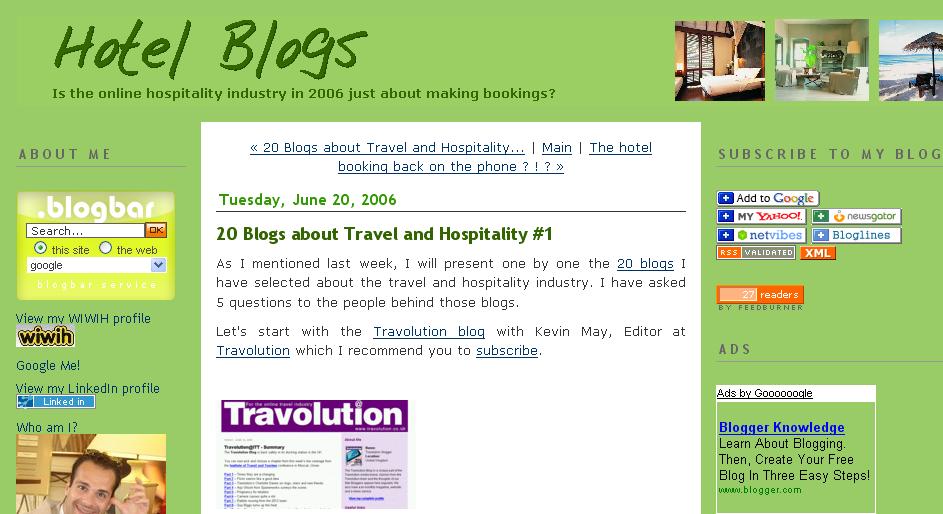
Travolution stars on Hotel-Blogs

Seems like the Travolution Blog has got a fan! [at last - Ed]

The excellent Hotel-Blogs, created by London-based Frenchman Guillaume Thevenot, got in touch this week and said it would be profiling us and 20 other travel-related blogs over the coming weeks.

[See our star turn on Hotel-Blogs here]

Kevin May, editor, Travolution

Creating storage for search

Toby Kesterson from LeadGenerators writes:

Flying over to the ITT conference in Oman I was in contemplative mood, thinking on how companies can enlarge their online footprint with minimal extra work.

I came to the conclusion that the most cost- and time-effective way of doing this is to put online as much of the offline company information as possible. Obviously this shouldn't include sensitive information, but any details about your products may work surprisingly well.

I'll give you an example of what I mean. One of the companies that we work for - outside the travel sector, admittedly - make a living by pairing up courier and haulage drivers with goods and loads that need moving.

For each new load put up on the site, a new page is generated. When the load is taken or if it passes the deadline, the page loses its original function.

Important keywords here, just as in the travel industry, are often location-related. This means that potential customers might be typing 'haulage loads nottingham' or 'small courier van tavistock'.

However, if there was a courier load posted to Tavistock last month, but there didn't happen to be one live at the moment then we would miss out on that traffic.

Bearing all this in mind, we recently we persuaded them to put up all the past loads online so that these pages could be indexed by the search engines and would be likely to appear when someone typed a relevant search into Google.

The results were astonishing. Our website suddenly developed a huge bank of valuable, relevant pages that the search engines were now busy indexing and caching.

Now, for every location that has had a courier or haulage load due to either arrive or depart, we have a page of relevant content that we can redirect to pages of current offers. This is the hook that lures customers into the site.

The question is whether this can work for the travel industry in the same way. Does it provide additional value for travel companies and tour operators to put their old offers online, or does the limited number of destinations mean that there is little if any advantage gained?

Is there a way for travel companies to get on board in a similar way; perhaps for customers searching for specific dates, hotels and pax numbers?

I'd love to hear your comments on the matter.

Toby Kesterton, head of search engine optimisation, LeadGenerators

Wednesday, June 21, 2006

Travolution - SOLD!

A few weeks back the Travolution Blog decided to take a look at what online auction house Ebay was doing in the travel arena.

Part of this was to illustrate – or poke fun at, perhaps – to those who had reacted with gushing reverence to a fantastic piece of PR at a recent industry event: that Ebay is, in fact, very much in the travel space already and is not about “enter the travel market”.

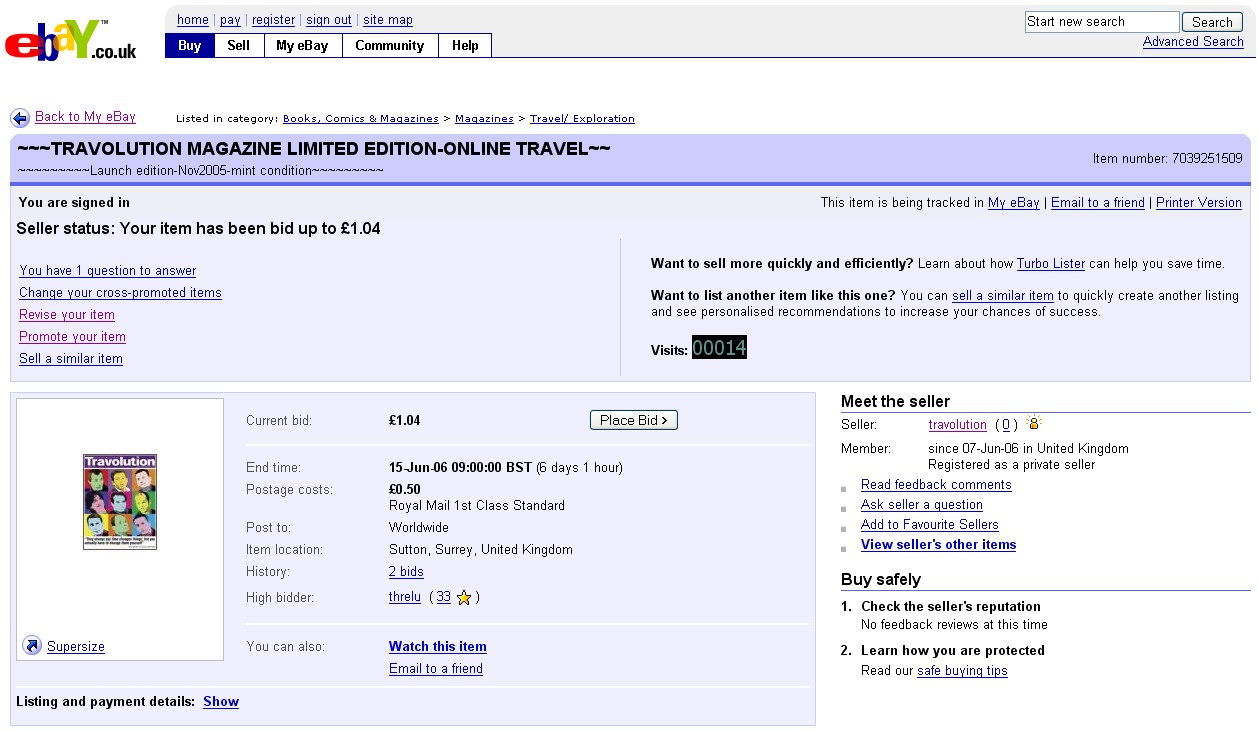
So, using Ebay’s travel channels, which already exist with all the functionality a travel provider could ever need to offload stock, we put the first, and now, limited edition of Travolution up for sale.

We admit that deep down it was a crushing blow to sell the item for only a measly £1.04 to Ebay user “Threlu” [come forward, stranger, you are now officially our biggest fan!].

But what our little experiment demonstrated is the potential Ebay has to make serious inroads into the travel arena – with a little bit of trade marketing, of course, which is exactly what the company was doing for free a few weeks back.

Tour operators, accommodation providers, if they wanted to, could easily use one of the most powerful and widely recognised sites on the internet to shift inventory.

What the barriers have been so far are difficult to determine – though the actual concept of an auction, with no guarantee of a decent return or a sale at all, is probably one of the main reasons.

Nevertheless, it will be interesting to see what other activity Ebay will use in the coming months to further plug its travel channel to the industry.

[See our original post]

Kevin May, editor, Travolution
Tuesday, June 20, 2006

Surely not - Troogle is finally here!

Don’t rub your eyes – you are not seeing things.

The image below is Troogle, Google’s long-awaited portal for travel - a development widely-anticipated with a mixture of awe and dread and one that is expected to take the industry by storm.


Well, not exactly. Those canny folk at the Search Engine War blog have mocked up what Troogle could look like based on the portfolio of products Google currently produces, many of which have been in Beta version for quite some time now.

[Read SEW’s original post]

Search Engine War’s top blogger, Teddie Cowell, told us: “The point we are making is even if Google were to do a bespoke travel portal, a lot services are already available anyway direct through the main search interface and have been for ages, but because they don't take up much real estate they slip under most peoples radar.

“Once you put them together though, you can really get a decent idea of how broad their travel offering already is.”

The Travolution Blog and Heather Hopkins at Hitwise have been pushing this issue for a few months now – but with continued denials from Google themselves.

The problem for Google is that very few people in the industry actually believe them.

Kevin May, editor, Travolution

Monday, June 19, 2006

Brand hijacking - a growing problem?

Heather Hopkins from Hitwise writes:

Travolution last week reported [see the story here] on the research published by Nucleus and Hallmark IP which shows that brand interception through PPC is on the rise. But are clicks to competitors and price comparison sites after a brand search also on the rise? My research which indicates it is on the decline - at least for the big brands.

Brand protection online is a huge issue and at Hitwise we recently published a white paper on the issue of search engine brand management that found that in the UK about 8% of searches for a brand send visits to competitor or price comparison website.

The number of visits on searches for misspellings of a brand name or keyword strings that include a brand name (i.e. "british airways flights to ottawa") were much more likely to send visits to competitors and price comparison websites.

[NB: If you haven't already read the white paper, I strongly encourage you to do so. Not just because I wrote it, but because it provides a guide to the protections offered by the leading search engines in the UK and offers tips on how to monitor which competitors are gaining visits from searches for your brand.)

Let's get back to the issue raised by the Nucleus/Hallmark IP research. I looked at Hitwise data on a few leading airline brands and found that a higher percentage of visits from searches for brand names are going to the brand owner websites compared with a year ago.

For example, while searches for "british airways" sent 80% of visits to the BA website in the past four weeks, last year, that figure was 69%. Which means that BA is receiving 16% more visits from searches for its brand name than it was a year ago.

Also interesting is that last year Hitwise recorded 309 different websites receiving visits from searches for "british airways" compared with the most recent four week period, with 149 sites - less than half the number from last year!

The following table [see below] shows an interesting pattern. It compares the share of visits from searches for leading airline brands sending visits to travel agencies. Travel Agencies had in the past been aggressive in trying to gain visits from searches for airline brands, whose inventory they sell.

The table shows a clear pattern that fewer searches for these brands are sending visits to travel agency websites compared with a year ago.

Hitwise UK year-on-year change in share of UK internet searches sending visits to travel agencies [four weeks to June 10 2006]:

Easyjet -31%
Ryanair -50%
British Airways -75%
BMI -72%
Flybe -32%
Jet2 +37%
Monarch -33%
KLM +2%
Virgin Atlantic -24%

The Nucleus/Hallmark IP research is definitely worth a read. It offers interesting insights into the trends in the area of brand hijacking. The issue of brand hijacking is an important one for any company that has invested in its brand - whether online or offline.

However, it is also important to note that the big airline brands have been more successful over the past year at attracting visitors who search for their brand.

Heather Hopkins, director of research at Hitwise UK

Read more from Heather’s blog here

Friday, June 16, 2006

The world of travel public relations

For those of you that have recently returned from the ITT conference in Oman, here's an amusing post on a blog for ad industry trade mag Campaign Middle East.

The title's Dubai-based editor and a former colleague at Media Week in the UK, Tim Burrowes, found himself on a very strange/frustrating/exhausting [make your own mind up] PR jolly to Abu Dhabi.

Brought back a few memories of being ferried around in Muscat this week by eager travel PRs. Thankfully our various trips went off much better...

[Read the adventure]

Kevin May, editor, Travolution

Travolution@ITT - Summary

The Travolution Blog is back safely in its docking station in the UK.

You can now pick and choose a chapter from this week’s live coverage from the Institute of Travel and Tourism conference in Muscat, Oman.

Part 1 – Times they are a-changing
Part 2 – Flickr seems like a good idea
Part 3 – Travolution’s Charlotte Davies on rings, rivers and new friends
Part 4 – Arjo Ghosh from Spanerworks surveys the scene
Part 5 – Poignancy for retailers
Part 6 – Camera causes quite a stir
Part 7 – Rabble rousing from the 2012 team
Part 8 – Sue Biggs turns up the heat
Part 9 – Arjo Ghosh from Spannerworks wonders if travel is lagging behind
Part 10 – Opodo brings fresh air to the second day
Part 11 – Search guys bamboozle delebates
Part 12 – Health warning from the quack
Part 13 – China full of eastern promise for travel industry
Part 14 – Industry bodies try to sort out their differences
Part 15 – Ed Whiting from Comtec sees a new world at ITT
Part 16 – Arjo Ghosh from Spannerworks sums up the week
Part 17 – Final farewell

Our pictures from the event are available on Flickr.

Kevin May, editor, Travolution

Thursday, June 15, 2006

Travolution@ITT - Part 17 - Final farewell

For some here it will certainly feel like the morning after the night before.

Bloodshot eyes peer around the breakfast room, trying to avoid bumping into someone new and the inevitable introductions that are synonymous with an event like this.

But for others it’s a time of reflection: most delegates are making their way home to the cooler climate of the UK and their day jobs – running travel businesses.

One far from bleary eyed boss says over breakfast that he has found the event a massively useful exercise for networking with very senior figures from the industry.

And the second day of sessions was more useful than the first. Fair comment, most delegates would probably say.

What is clear, and has been reflected in many comments from delegates, is how online travel has become an important part of discussions, both on stage, in the bars and restaurants and at the various functions.

“Just a few years ago we would never have had a session about online consumer trends followed by a double header from the search engine guys,” one delegates said last night.

[Read our posts on the Opodo presentation and Google and Yahoo!’s]

Progress? Or the reality of an industry being dragged into the digital world at a blistering pace?

We think the latter.

Kevin May, editor, Travolution
Travolution@ITT - Part 16 - Spanners and clarity

Arjo Ghosh from Spannerworks signs off:

Wednesday 2am: Things are hazy but we have help at hand. Another agency is going round the bar telling people that Spannerworks sells spanners. This is good news, it means I can go to bed safe in the knowledge that by 6am we will be semantically linked to mechanical tools for the travel industry forever...

Wednesday 10.30am: “Fellow travellers become your online travel agent”. We have just had the session on search with both Google and Yahoo! contributing a range of ideas and tools that the travel market could utilise in developing their search marketing channel.

In contrast to presentations as recent as last year by the big search engines, both Esteban Walther from Google and Nick Jones from Yahoo!, today’s search engine is a more open and informative media partner.

Yahoo!'s development of industry research is hugely useful for marketers and Google's willingness to, at last, discuss their agenda more openly is refreshing and long overdue.

Noticeable from both presentations is the way in which they see social communications and media contributing to the travel industry. Although much of their income is from paid search advertising, the engines place user engagement as a key aspect to their long-term planning.

For a travel marketer there are a range of low-cost tools, including Google Maps, Flickr, and multimedia content that can be developed into the travel channel.

If search engines are placing social communications at the centre of online community engagement then the tide for online travel offers is surely unstoppable. Adapt your content and let your customers engage before your competitors [the most notable example of which is Thomson.co.uk] do – or lose out.

Nick also presented Yahoo! Answers, the new service that allows users to ask a question that can be responded to by a community, defined by the interests.

Again the community becomes the influence on the travel purchase decision with potential customers getting their advice from a peer, prior to any engagement, if any, with the brand.

My thinking is clearly starting to join-up, not just in search, but for the whole of Web 2.0 and the possibilities for travel. It takes a while to absorb the wave of new technology and how people are using it in ways that suits them, but the fog eventually lifts.

Customer engagement is hardly a new concept, but communicating with your customers on their terms is clearly a new challenge, particularly in the digital channel.

Like it or not, peer-to-peer marketing is here now, and the fun is only just beginning.

[Conference photos on Flickr]

Arjo Ghosh, chief executive, Spannerworks

Wednesday, June 14, 2006

Travolution@ITT - Part 15 - Lazy Boys on the Lazy River?

Ed Whiting from Comtec writes:

This year we are seeing the change and innovation in the travel industry established and in full swing. It has come probably quicker than most had anticipated.

At the ITT this year it is evident that among the varied range of companies attending - the usual crowd of traditional media, traditional principals, traditional tour operators and travel agents - there are online tour operators, bed banks, technology companies, search engines, new essential consolidators, online travel agents also here.

These companies have embraced the change and I would bet that there are not many companies attending that haven't embraced the change.

What is the change? Hard to describe exactly but the internet/technology has a big influence, being a catalyst for new business models, new distribution channels, new ways of selling travel direct, and new entrants.

Only two to three years ago I remember when the new players such as Expedia, Opodo and Lastminute.com were scorned upon as the bad dangerous entrants into the market place that people steered away from and didn't understand.

Now they are the norm and very accepted rubbing shoulders with the traditional businesses. At this year's ITT we are seeing search engine companies, which are one of the fastest growing distribution channels for the industry.

This time I note that they are already being accepted into the travel community a lot faster than the likes of Expedia, Opodo, Lastminute.com – the travel industry is getting used to the change.

Why the title? Well at the conference there is a circular man-made river running between two of the hotels which is used to transport hotel guests on lie-back inflatables.

It is called the Lazy River. I was amongst several delegates gliding down the Lazy River to the next bar – looking at them you could of easily thought that they were a bunch of lazy boys.

However, reality is that these are the people from new successful travel businesses and are relaxed with the fast pace of change.

[Conference photos on Flickr - including the Lazy River and a member of the Travel Weekly team]

Ed Whiting, product director, Comtec (Europe)

Travolution@ITT - Part 14 - Happy families

Travel writer Bill Bryson, alas, is unwell and has been unable to make the eight-hour flight to Oman to round up the second day’s events.

A collective feeling of disappointment hangs in the air.

Fear not, Nicholas Witchell says, as Hoseasons boss Richard Carrick has admirably stepped in to fill Bryson’s shoes with a Q&A session

ITT has hastily re-arranged the morning’s programme to include the Q&A, which turns out to be an interesting session that features, amongst other issues, the thorny issue surrounding fate of industry bodies.

President of the Association of British Travel Agents, Justin Fleming, says he is doesn’t see a future for a plethora of trade associations, when - for example - so many travel companies are doing the same thing.

It turns out that Abta and the Federation of Tour Operators, represented on stage by Andrew Cooper, have recently stopped “discussions” about a merger.

This doesn’t really surprise many delegates – “the United Nations would have problems getting those two to agree”, one delegate says later.

[Conference photos on Flickr]

Kevin May, editor, Travolution

Travolution@ITT - Part 13 - Chinese opportunity

Tim Haynes, assistant editor of The Times, has been drafted in to replace Seema Desai, director of the Foreign Policy Centre, to talk about the emergence of China.

He warms up by poking fun at the previous day’s opener, Paco Underhill from Envirosell (“Paco Underhand” he laughs).

Some delegates chuckle; others squirm at the references to the length of time it took Underhill to complete his speech yesterday – this is unfortunate for Underhill, who is clearly not in the audience, as he has an obvious stutter.

Anyway, it’s a double act from The Times.

The paper’s travel editor Cath Urquhart talks about the implications for the travel industry in the world’s biggest country, while Haynes outlines the political and social circumstances that have led to its open-door policy for tourists.

There is also an interesting section on the influx of Chinese tourists to the UK as well. Some attractions will have to adapt to the siege mentality associated with coach loads of tourists, Urquhart says.

[Conference photos on Flickr]

Kevin May, editor, Travolution
Travolution@ITT - Part 12 - Health warning

The rest of this year’s ITT conference has been taken up various issues, but has focused less on the online travel sector.

This is perhaps a welcome relief for those blown away by the early presentations of the day, which gave an indication as to where the industry is heading – and how complicated yet vital the internet has become.

Doctor Thomas Stuttaford, a renowned practitioner in the travel sector, has frightened and amused delegates with comments on gap year and student travellers in the jungle and some of the horrifying things that happen in terms of general health when tourists flee the shores of Britain.

[Metal note: stop glancing nervously at the scar on right arm from where an insect emerged during a – surprise, surprise – trip to the jungle in South East Asia as a student]

Kevin May, editor, Travolution
Travolution@ITT - Part 11 - Bamboozle time

So bring on the search guys!

Esteban Walther from Google and Nick Jones from Yahoo! Search Marketing are on stage for a session moderated by Simon Ferguson, Travolution’s publishing director but here today with his DG&G Travel Information hat on.

Both are doing a good job of wowing the delegates with terrifying (for some) statistics about the amount of business generated through search engines.

One couldn’t help noticing that classified advertising in newspapers is considered one of the least effective methods of targeting consumers.

This is probably something one of the event’s headline sponsors, Times Newspapers, would rather have been omitted from the presentation.

It’s not all stats and graphs about the role of the internet in the travel marketing mix – there’s plenty to woo delegates on the social media side.

Jones does a good job of explaining the role of Flickr and Blogs [with a plug to the Travolution Blog and our showreel from the event. Cheers!].

Bamboozle moment of the presentation: Walther is showing off Google Earth and makes reference during the Q&A to images of the UK capital where you can now see the heads of Londoners.

A delegate in a row in front leans to her colleague and whispers: “This is f***ing madness!”

Indeed it is. But it’s what the internet can do and where travel can take a leading role…

Kevin May, editor, Travolution

Travolution@ITT - Part 10 - A bright start

The second day begins with high relevancy for the online travel industry – a session from Opodo and another on the thorny issue of search and the emerging social side of the web.

Opodo’s man in Oman, Chris Rowe, who is standing in for the boss Simon Vincent, is unveiling a heap of brand new research on the European online marketplace.

He forecasts that the UK will have 25% of travel products booked online by 2010, though this is way behind the US, with an estimated 50%.

Once again the phenomenal rise of the internet seems a bit bewildering for some in the audience.

Some delegates sit open mouthed at the statistics in the research, while there is an obvious and sharp intake of breath (perhaps from Sue Biggs at Kuoni?) when Rowe reveals 78% of those questioned said price was the dominant factor in their online purchase.

Understandably, Rowe manages to shoehorn a plug in for Opodo’s online dynamic packaging service which has launched – right on cue – today.

[Conference photos on Flickr]

Kevin May, editor, Travolution

Travolution@ITT - Part 9 - Lagging behind?

Arjo Ghosh from Spannerworks writes again:

Monday 7.30pm. Quote of the day: “Travel is 5 years behind online.”

To demonstrate why a never-say-die attitude can lead to amazing results, Australia came back from 0-1 down with six minutes to play to beat Japan 3-1 in the World Cup this evening.

So is travel missing the boat with digital? Are the huge range of medium/small size travel operators, agents, and suppliers embracing online as quickly as they should?

Everyone is still learning the rules - what works, what doesn't. The low-hanging fruit, for example in sponsored search, are less common. As the big players pour more money every day into search engine marketing each click increases in price, and every new customer costs more to win.

Although my link with football is less than tenuous, it's worth considering that online is still in its infancy and the cost-per-click advertising model so successful for Google, Yahoo! and many others is only six or so years old.

If a campaign is meticulously researched and designed well, the execution has a better chance to succeed, now matter when you start.

There's no such thing as “missing the boat” in online. Barriers to entry are low, knowledge is plentiful and easy to acquire and new ways of improving old formulas are constantly being created.

Between goals during Australia’s late victory, I had the chance to catch-up with a couple of experienced suppliers to the travel industry. They had strong opinions. “Travel is five years behind” (I quote) is the opinion. Everyone wants to get in and make it work, but talent is hard to find agency-side.

Tuesday 3.30am. The singing in the bar has begun. It's time to go to bed.

[Conference photos on Flickr]

Arjo Ghosh, chief executive, Spannerwork

Tuesday, June 13, 2006

Travolution@ITT - Part 8 - Biggs turns up the heat

So finally we have some meaty material for delegates to get our teeth into.

Sue Biggs, UK boss of Kuoni, is on stage for what seems like a cosy fireside chat with Michael East.

She has reaffirmed the long-haul operator’s commitment to selling 15% of holidays direct to consumers and admits to being on the acquisition trail.

Questions fly in from the conference floor about the general long-haul market (it’s growing “rapidly”) and how does Kuoni cope with world events like hurricanes, the tsunami and wars (they happen and the market copes “very well”).

There are others about commissions to travel agents – a thorny issue in the light of Thomson’s activities in the last year.

Biggs praises travel agents to the hilt but points out that their commission levels were lower than those paid by the big tour operators in the first place.

But light hearted moment of the session comes when Biggs is speaking about the type of holidays booked online.

While most industry people argue that consumers are still keen to carry out large transactions with an agent or at least a voice on the phone, Biggs admits that Kuoni recently took a single online booking for seven people to the Maldives, costing around £46,000!

Now that’s faith in the system…

Kevin May, editor, Travolution

Travolution@ITT - Part 7 - Olympic spirit

After some not so subtle pointers in the right direction in the “Zen-like act” of retail mastery, things changed tact somewhat.

Marketing and sponsorship director for the London 2012 Olympics Organising Committee, Philip Beard, has taken delegates back 12 months to when the UK’s capital beat off a bid from Paris in the controversial vote to become host city.

Right on cue, an M-People laden video montage - of course - has fired up delegates to spontaneously applaud London’s achievements.

Not a lot of new information from Beard, however, but a good and stirring reminder to the travel and tourism industry that in six years time London and the UK – as he was at pains to point out a few times – have a massive opportunity to seize upon the greatest show on earth [Is that after the World Cup? Discuss!].

However Beard made slight omission, although only the online types among the delegates probably noticed.

One slide outlined all the organisations and industries the organisers will be working with in the run up to the event.

On the media side, a slide on the screen listed television, radio and press as partners.

Just in terms of money spent on advertising in various media channels, online passed radio at least six months ago and is widely expected bound past national papers pretty soon.

And who knows where online media will rank in 2012.

Consider yourselves chastised…

[More Flickr photos here]

Kevin May, editor, Travolution

Travolution@ITT - Part 6 - More photos

We have uploaded more pictures from the ITT conference in Oman to our Flickr showreel.

Click here to go direct to the site.

Imagine the shock on the faces of two delegates sitting alongside as pictures were taken on a mobile phone, plugged into a laptop and then live on Flickr within minutes.

Kevin May, editor, Travolution

Travolution@ITT - Part 5 - Poignancy for retailers

So, at last, the actual conference begins.

After the dignitaries have exchanged gifts and patted one another on the back it’s down to the serious business of the day and why 400 delegates have descended on Oman.

First up is a chap called Paco Underhill, who runs a New York-based retail consultancy firm called Envirosell and has, perhaps, been brought in to scare the hell out of High Street travel agents.

His job is the dark art of establishing what consumers want, or what consumers should be offered, in the retail environment.

In short: the consumer is changing its shopping behaviour due to increasing pressures on their time; women will come dominate the buying process; and the traditional retail space is not the most efficient or lucrative way to interact with customers.

What Underhill hinted at very cleverly with his presentation was how the traditional travel agent shop is now very much an outdated and unproductive model.

He managed to attract a fair few laughs from delegates, but there was a certain feeling that much of what he was saying will strike a poignant note with many in the room.

Rather disappointingly, for an industry seeing so much of its revenue being generated online, there was scant mention of the internet and its role in the process.

[The BBC’s Nicholas Witchell, the moderator for the two morning sessions, didn’t allow questions from the floor!]

Kevin May, editor, Travolution

[Pictures from Flickr here]

Travolution@ITT - Part 4 - We can all adapt to the new world

Arjo Ghosh from Spannerworks writes:

So 40 degrees in the shade, a "lazy river", with inflatable rings for good measure winding its way through the resort, and thus far impeccable service and food make my first ITT a memorable visit - and that was only day one.

Although ITT's annual soiree is more intimate and less structured than Abta’s convention, the open nature of the travel industry is still very much evident.

Delegates are equally happy to share their knowledge and to discuss issues facing the industry, including the challenges posed by digital media.

Although still very much focused on the ROI performance of their interactive marketing, I sense that, at a senior level, the integration of content, brand, and multiple distribution channels is being seriously debated and I eagerly look forward to Wednesday's session on search.

My guess is that many travel professionals “get it” faster and in greater depth than other industries and are willing to do something about “travel 2.0” now.

The challenge to specialist agencies like Spannerworks is our adaptability. Travel needs are sometimes unique and always varied - isn't this what online was made for?

So, so far, refreshing, enjoyable and highly interactive, but not in a digital sense.

Arjo Ghosh, chief executive, Spannerworks

Monday, June 12, 2006

Travolution@ITT - Part 3 - Sinks and lazy rivers

A relieved Charlotte Davies, of Travolution, writes:

A lot has happened since leaving the shores of a hot and sunny England.

For one, England no longer seems so hot and sunny compared to the blistering heat of Oman, and I am reminded, once again, of how fortunate I am to be working in the travel industry, attending my first ITT conference in Oman.

Staying in the recently opened Shangri-La Resort, near Muscat, I am astounded with the friendliness and helpfulness of the people of Oman, particularly those working in the hotel.

It was never my intention to test the service levels of the hotel, but when the duty manager turned up at my room, upon my request for a hairbrush earlier in the evening, at 1am – naturally which I needed desperately – I realised I was in for a treat.

Around midday today, I managed to lose my contact lens down the sink. Immediately a three-man team arrived to dismantle the sink and rescue the missing yet important part of my body.

Again I do not plan for these to happen [Really? Ed], but I would rather they happen when I stay at a Shangri-La resort than anywhere else.

Anyway, I am here to work, so after a dolphin spotting trip, I wandered to the pool, to make new acquaintances. Luckily, my colleague Jackie, from DG&G, was there to provide new contacts en masse.

Later in the afternoon, I found myself in a rather bizarre situation, floating in an inflatable dinghy down the Lazy River, which connects the Al Waha and Al Bandar hotels in the resort.

A fellow floatee, a thoroughly pleasant Scotsman, called Brendan, from long haul tour operator If Only, repeatedly asked me: “What do you do at Travelocity?”

Crushed, after ten months plugging this Travolution brand of ours, I now realise that my work is not yet complete!

[Thanks to Kieran from Virgin Holidays, Frank from Traveltek, Diane from Toner Marketing, Matt from Teletext Holidays and, of course, Brendan from If Only, for making this an enjoyable visit so far]

Charlotte Davies, sales and sponsorship manager, Travolution

Travolution@ITT - Part 2 - Photos

We have set up a new Flickr album for photographs from the ITT conference in Oman.

Click here to go straight to the showreel. We will add to the collection once the conference starts in earnest tomorrow.

[All photos were taken with a Nokia N70 camera phone]

Pictures from the Travolution Summit are still available.

Kevin May, editor, Travolution

Travolution@ITT - Part 1 - Times they are a-changing

This week’s ITT conference in Oman begins tomorrow morning (Tuesday 12 June) but the 400-odd delegates have descended en masse over the weekend on the brand new Shangri-La complex, which sits a few miles east along the coast from the capital Muscat.

Alongside the obvious comments about the heat (around 40 degrees at Seeb International Airport yesterday evening), delegates are in an upbeat yet contemplative mood.

“The industry is on the verge of massive change – again,” one senior figure said on the flight last night.

The early adopters in the online world have set the pace, but now the others – especially the traditional tour operators – are catching up fast, he said.

It appears, talking to delegates, that the travel industry is about to experience its own Version 2.0.

If the gradual switch over the last ten years was the warm-up act, then the next few years will be the main show.

To some here it feels like the wait-and-see approach has now ended. It is time for the Big Boys to really enter the fray – and, in turn, turn up the heat on the rest of the industry.

“They have the power and influence gathered over the decades to have a massive impact,” the delegate said.

[Check back here for regular updates from Oman]

Kevin May, editor, Travolution

Saturday, June 10, 2006

Travolution@ITT

The Travolution Blog is switching operations to the Middle East over the next five days to coincide with the Institute of Travel & Tourism’s annual conference in Oman.

The conference takes place on Tuesday 13 and Wednesday 14 – and the Travolution Blog will be there to report back with observations of the event.

Senior figures from the online travel industry will also be helping out, adding their comments here on the Blog during proceedings.

Check back here regularly for updates.

Kevin May, editor, Travolution

Friday, June 09, 2006

The Travolution Guide to travel on Ebay

With the weekend almost upon us, the sun shining here in the UK, and the England football team just three matches away from an early exit in the World Cup, we thought it might be a good time to have a little fun.

The cue for this: a collective rush of blood to the head among assembled hacks and travel execs earlier this week at an industry conference.

Online auction powerhouse Ebay is to make its presence felt on the travel industry, most of those present managed to deduce in some way or another following a debate on Monday.

The reality is that Ebay has been trying for years to stamp its already enormous online presence on the travel market, but without huge success, apart from in a few individual countries such as the US, where it hired the help of a small and unknown online travel agent called Expedia.

Of course some might argue that the actual “news” is the fact that Ebay is doing a fine job of creating PR about its travel category on the site in order to get people and the travel industry to use it.

So what can consumers buy, or travel companies sell on Ebay at the moment – and have been able to do so for quite a while?

The answer is actually pretty much anything. Hoteliers can sell rooms; tour operators can sell holidays; airlines can sell flights; shipping companies can sell luxury cruises.

There is actually an interesting discussion to be had about whether a non-travel internet company like Ebay can have a serious impact on the status quo.

But to demonstrate how easy it is to get up and running, Travolution has decided to sell a travel product on Ebay. The perfect travel accessory: a copy of Travolution!

Users can find this very limited edition of the first Travolution [1.0] in the travel section on Ebay.

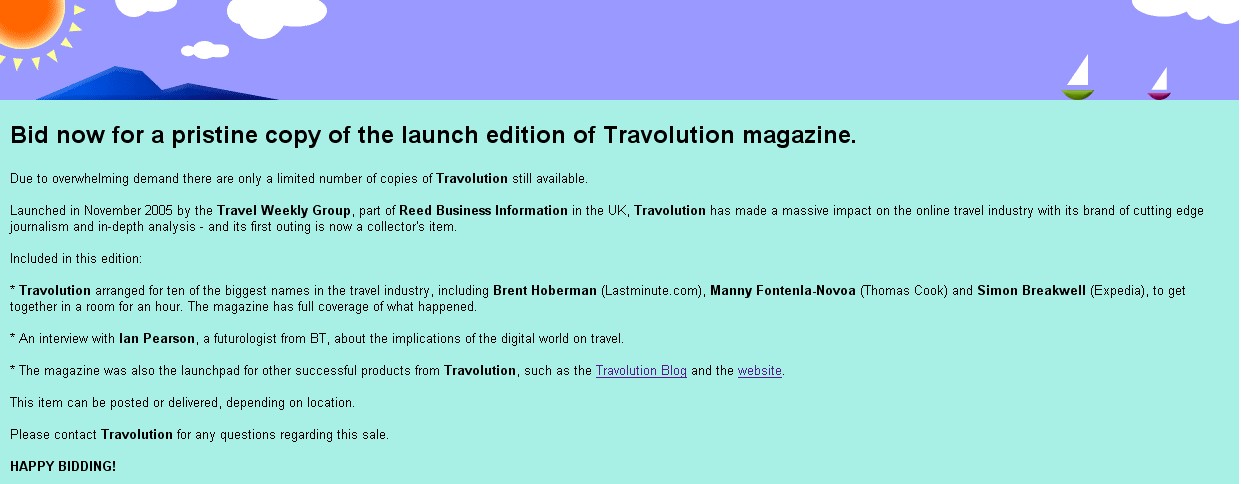
Travolution was able to pick and choose how many pictures it wanted to include in the auction and also a suitably – and somewhat dazzling – travel-related wallpaper background. Travel companies, with the time and also some expertise in HTML, can actually create quite a decent advertising platform for their products.

[See the page here]

In the meantime, the auction ends on Thursday 15 June at 9am. Proceeds from any sale will, obviously, go to a suitably good cause.

[At the time of publication, our mint condition, limited edition magazine had actually received two bids, with £1.04 GBP already under the hammer]

As they say in Ebay world: Happy bidding!

Kevin May, editor, Travolution


Thursday, June 08, 2006

Troogle would have a battle on its hands

Heather Hopkins at Hitwise writes again:

To follow on from fellow Hitwise blogger Bill Tancer’s wildly popular post on how Google, Yahoo! and MSN's properties stack up, I wanted to share the same data from the UK market.

We are publishing these stats alongside the US market stats in a search report this week. If you'd like a side-by-side comparison, you can request a copy of the report from the link on our home page.

We found that similar to the US, Google's search property is hugely popular while many of its other sub-domains have yet to take off. Each Google property that is announced creates a storm of attention from commentators and search enthusiasts.

However, UK consumers don't seem to be paying a whole lot of attention.

The most extreme example is Google Finance, which ranked #201 in the week to 20 May 2006, with .04% of category visits. Yahoo! UK & Ireland Finance was ranked #1 by contrast, with 8.30% of category visits.

Google certainly does have a lot of weight to throw around, powering 77% of UK internet searches, but that doesn't mean that Google dominates in all of the verticals it enters - as the table below illustrates.

I had a good catch up with Simon Ferguson and Kevin May at Travolution today [thanks for plug – Ed]. We chatted about the possible impact of Troogle in the UK. Based on the table below, if Google were to enter the Travel vertical search space - it might not have the impact we in the industry expect.

[More Troogle on Hitwise Blog here]

Portal property ranking and market share by vertical, week ending 20 May 2006

Computers and Internet – email services

1 MSN Hotmail (52.37%)
2 Yahoo! Europe Mail (17.16%)
3 Yahoo! Mail (6.33%)
8 Google Mail (2.2%

News and Media

1 BBC.co.uk (15.82%)
2 BBC News (13.59%)
5 Yahoo! UK & Ireland News (1.67%)
7 Google News UK (1.48%)
14 Yahoo! News (0.76%)
28 Google News (0.39%)

Business & Finance – business information

1 Yahoo! UK & Ireland Finance (8.3%)
5 MSN Money UK (3.46%)
6 MSN MoneyCentral (3.19%)
10 Yahoo! Finance (2.95%)
201 Google Finance (0.04)

Travel – Maps

1 Multimap.com (32.44%)
2 Streetmap.co.uk (15.11%)
3 Google Maps (13.11%)
5 Google UK Maps (4.49%
6 Google Earth (3.98%)
12 Ask.com UK Maps (0.69%)
16 MSN Virtual Earth (0.47%)
22 Yahoo! Maps (0.27%)

Shopping & Classified – Rewards and Directories

1 Kelkoo (9.98%)
2 Shopping.com UK (4.4%)
7 Froogle UK (2.49%)
11 MSN Shopping (2.16%)

Heather Hopkins, director of research, Hitwise UK

Read more Heather’s Blog here

Wednesday, June 07, 2006

Let technology take the pressure

Gillian Gibson from Amadeus, one of our new Star Bloggers, writes:

Airlines like selling flights. Right? Right. Online travel agencies like selling airlines’ flights. Right? Right. But the two aren’t exactly love-birds, so what’s going on?

Online travel agencies put a heavy load on an airline’s reservation system because consumers are less efficient searchers than travel agents. Consumers like to browse and try out different alternatives; travel agents tend to go straight to the best flight option.

Each time a website is searched for flight availability, the airline’s system has to respond. To give you a sense of scale, I can share some figures from Amadeus’ own system.

In 1996 each booking took an average of 26 transactions (operations the system is required to make). So far this year, the average is 150 transactions per booking. This, indirectly, costs the airline money.

The issue can be mollified by better aligning the needs of airlines and online travel agencies. Airlines want high bookings and low transactions. Online travel agents need availability information fast.

Smart caching technology reconciles these two positions by adding an extra layer between the online travel agent and the airline: the online travel agent queries an intermediate server instead of the airline’s system.

The intermediate server in turn gets periodic updates from the airline’s system. The trick lies in developing technology which can infer when these updates should be made: accurate and up-to-date availability information must be balanced with minimal load on the airline’s system.

No-one is going to reverse the trend towards more transactions per booking. It is a side-effect of giving consumers the choice to make their own bookings which, in itself, has countless benefits for the travel industry.

But there are certainly ways to smooth the process. All it takes is a little understanding, a lot of late nights and some smart technology.

Gillian Gibson, vice president, Multinational Customer Group, Amadeus

Tuesday, June 06, 2006

Throw your keyboard onto the fire

A few months back, Vic Darvey from Lastminute.com told Travolution that 2006 would be the year that Voice Over IP really starts to kick in.

He was actually talking in relation to how he expected travel companies to communicate internally and also with their clients.

[Read the feature in Travolution 3.0] [What is VOIP? Click here]

It now emerges that another online travel company is about to test the water using that rather more fickle group of people, most call consumers.

This will not be with VOIP per se, but using voice recognition software to allow consumers to effectively “self-serve” on a travel website.

Flythomascook.com, the site for low cost air tickets on Thomas Cook charter flights, is to pilot the system with technology company RightNow, who have just been picked to handle other CRM duties.

[Read the news story]

This is an interesting development in many respects. In the past, many journalists, for example, played around with voice recognition software when trying to find an easy [lazy?] way of transcribing recorded interviews or panel discussions.

At the time the gear was often not up to the job, with accents or the quality of the recording playing a key factor in whether the software actually picked everything up verbatim.

Clearly those days are long gone. If Flythomascook.com’s trial is successful, then the opportunities for them and other travel sites will become very exciting.

In its simplest form users will be able to book travel products purely by talking to computer.

In the meantime, the advances in VOIP, where one of the leading providers, Skype, has been widely predicted to come to the fore during 2006, though it’s more likely to me next year now, could speed up enthusiasm with consumers.

Clearly it will be a long while before waste bins across the land are filled with computer keyboards.

But it’s a gradual step towards how differently consumers will interact with the Internet in general and travel sites in particular.

Kevin May, editor, Travolution

Sunday, June 04, 2006

Search silver medal for Yahoo! and MSN

A note from Heather Hopkins at Hitwise:

In preparation for publishing our UK Search Research Note this week [you can request a copy here] and with SES London in full swing last week, I wanted to share some stats on the UK search market.

Google powered three-quarters of all UK searches in the four weeks ending 20 May 2006 - combining the .com and UK properties.

While it is always astonishing to see Google's strength in the UK – there's nothing really new here.

What's new is that MSN Search and Yahoo! Search are now tied for second in the share of executed UK searches. MSN Search and Yahoo! Search (again combining the UK and .com properties) each powered just over 7% of UK searches.

1 - Google UK is the most visited website in the UK, receiving more than twice the share of visits compared with MSN Hotmail, the #2 ranked site.

2 - Google UK, MSN.co.uk Search, Yahoo! UK & Ireland Search and Ask.co.uk together powered 82% of all UK internet searches in the four weeks ending 20th May 2006. Combining the UK and .com properties for these search engines that number climbs to 96%.

3 - In the US, Yahoo! Search is a stronger competitor. Amongst US internet users, Google.com powered 59% of all searches, compared to Yahoo! Search at 22% in the four-week period ending 20th May 2006. MSN Search powered 12% and Ask.com, 4% in that same four week period.

4 - Hitwise data indicates that visitors to Google are performing multiple searches and using the search engine as a point from which to navigate the web.

First, comparing share of visits with share of executed searches, it is evident that Google powers a much larger share of searches relative to the share of visits the site receives.

Second, visitors to Google UK spent an average of 13 minutes and 30 seconds on the site in the week ending 20th May 2006; this is 2 minutes and 46 seconds longer than visitors spent on Yahoo! UK and Ireland Search, the search engine among the leading 4 with the second longest session duration.

Third, as with all search engines, the highest volume search terms on Google UK are navigational. In the four weeks ending 20th May 2006, the highest volume searches on Google UK were "ebay", "hotmail", "bebo", "yahoo" and "argos".

Heather Hopkins, director of research, Hitwise UK

Read more from Heather’s Blog here

Friday, June 02, 2006

Travolution and WTM - Official

As the intro to our e-news today reveals…Travolution has an exciting and major announcement to make.

Following the success of the Travolution Summit in April we have been invited to run a two-day online travel and technology-themed event at World Travel Market in November.

[Read the full announcement here]

Further details will be unveiled in the coming weeks but we can reveal Travolution will be hosting a series of seminars on Tuesday 7th and a major one-day conference on Wednesday 8th, in partnership with this year’s WTM in London’s ExCel.

In the spirit of Travolution’s aim to be a media brand of the future, the one-day conference will include video link-ups and live blogging as well as a line-up of speakers to ensure visitors will come away with a delegate pack full of ideas as to where other sectors are heading in the digital world and how travel will be a part of it.

The seminars will be headed by some of the leading innovators and providers of technology and online marketing for the travel sector.

We are, of course, thrilled to be involved with WTM, which is run by Reed Travel Exhibitions, and confident that this development signals another step in our rapid growth as a media brand for the online travel industry.

In the meantime, we’ve just got the small issue of putting our latest edition [June 4.0] to bed.

[Sign up here for our regular e-news bulletins]

Kevin May, editor, Travolution

Thursday, June 01, 2006

A question of semantics for travel search

Imagine a world where the consumer doesn’t have to wade through tons of results from a search engine when they type in, say, “flight New York”.

Hooray!

Okay, so search engines are already getting becoming sophisticated in that they and pay-per-click advertisers can produce results from on a relatively lengthy query, such as “flight heathrow JFK july 22 return august 2”.

But now a number of brainy people in the IT world are beginning to reveal what is likely to be the next significant growth area for search engines – one which will apparently make the life of the travel consumer far easier.

The so-called Semantic Web, an idea from the minds of Tim Berners-Lee (he of World Wide Web fame) and two eminent professors, will allow every possible piece of data available to be digested by complicated systems and, essentially, carry out “intelligent thinking” on behalf of users.

The Semantic Web is not a new concept, by any stretch of the imagination - it's just how it might be applied that is becoming clearer.

For the online travel industry this could be pretty fundamental. One interpretation highlighted at last week’s 2006 World Wide Web conference in Edinburgh is that rather than the current simple search, users of a semantic search engine would be far more able to make the right decision.

Travellers could effectively ask a search engine to bring back results on a hotels based on their own preferences, such as price, location, availability, facilities, connection with flights, food requirements.

This isn’t too far off, depending on who you listen to in the industry, but the Semantic Web gets very exciting when the prospect of personal travel agents comes into play.

Professor Wendy Hall from Bournemouth University, in an interview with the BBC at the conference, reckons the Semantic agent will be able to pick a holiday for users and possible even negotiate a price.

Clearly the “search providers” or those about to embark on this type of search will have to extract the vital information from users.

And who is already best placed or in a strong position?

It’s no wonder that the likes Yahoo!, MSN and AOL have been creating vast databases about their users, and why Google is so anxious to push personalised products such as GMail.

[Click here to see Swoogle, a prototype Semantic Search Engine, built by the University of Maryland, for academics]

Kevin May, editor, Travolution