Friday, April 28, 2006

Travel - The Next Generation

Lyndsey Hawkins, a 20-year-old student studying tourism at Portsmouth University, attended the Travolution Summit yesterday as part of an undergraduate sandwich course within the industry.

We asked Lyndsey to send us her impressions of the event and the industry in general.

She writes: “As a tourism student at Portsmouth University and with my final project nearing I was delighted to attend the Travolution Summit in London.

“My interest has always been in the growth and expansion of the online travel industry as this, in my opinion, is the future of the travel industry.

“There were a lot of issues raised in the Summit of which I was naively unaware – and a lot of others that hadn’t even crossed my mind.

“One comment that stuck in my mind was something that Ian Pearson [the BT futurologist) touched on about how in 15 years time computers will be more intelligent than their creators.

“With this in mind it struck me that if computers will be doing our jobs in so many years time, I am being lectured and trained in skills that I may not need and thus I feel that the tourism courses need to be restructured in line with the future of the industry and making placement years compulsory.

“On another topic, my impression of the travel industry is that customers wanted to travel, but the revelation to me about ‘cyber travel’ came as quite a shock, not having been heard any lectures about it at university.

“As my final project was going to be about online travel, my discussion was to be based around the phasing out of High Street stores due to the increase on online booking. Now I feel I have not been thinking ‘outside the box’ and there is this whole new world out there.

“I feel the concept of an imaginary beach in your lounge defeats the object of having a travel industry - you don’t travel! I wanted to get into this industry to give the customer an ‘experience’ but not of a cyber world…a real world!

“We may end up living in a Matrix style world, which I feel is rather scary and considering some people still like to live in the so-called dark ages, does the industry really think that today’s society is advanced enough to cope with this?

“I feel that this is one of those ideas that isn’t so good and is more about a company trying to get a competitive edge.

“It seems if you snooze you lose in this industry but I worry if the world is really ready for ‘cyber travel’.

“But, of course, this is the opinion of someone new to the industry!”

[The June edition (4.0) of Travolution will be taking a look at courses coming into vogue, such as E-Tourism, which are now available to the industry and postgraduate students].

Kevin May, editor, Travolution

Summit feedback

Heather Hopkins from Hitwise sends some comments about the Travolution Summit yesterday:

“I found that [Lastminute.com chairman] Brent Hoberman’s presentation was very insightful and inspiring, especially his comments on the opportunity for a MySpace-like community in travel.

“Travel is among the best placed industries to take advantage of consumer generated content through not only reviews and photos, but videos, itineraries and tips for fellow travellers.

“At Hitwise we have seen an explosion in visits to online communities, Blogs and video sharing.

MySpace, Bebo and YouTube are among the most popular websites. They are attracting a young audience, but kids influence family holiday locations and today’s kids are tomorrow’s travellers.”

[Read Heather's Blog here]

Kevin May, editor, Travolution

Thursday, April 27, 2006

Live from the Travolution Summit - Part 4

2.30pm:

The presence of Laura Wade Gery, chief executive of Tesco.com, at the summit is baffling people somewhat.

Why would she attend almost the entire conference, rather than the usual in-and-out approach favoured by many high fliers at these events?

Sure she has an interesting tale to tell but also coming along with a business development manager? No wonder tongues are wagging over lunch.

Following her presentation, Travel Weekly editor Richard Siddle asks her if the supermarket giant will explore moving into travel.

We would never rule anything out, she admits.

Cue further wagging of tongues.

Travolution Blogger at the Summit

Live from the Travolution Summit - Part 3

11.30am:

Tim Davis, senior vice-president for commercial development and IT of Hilton Hotels has told delegates one of the main reasons for pushing hotels online is for the opportunity to raise the profile of brands.

He seems at loggerheads with other speakers here today, in that personalisation – which had dominated conversations – is not a key factor in the Hilton strategy.

“We are not striving to personalise the brand,” he says.

Travolution Blogger at the Summit

Live from the Travolution Summit - Part 2

11am:

Brent finally arrived and, as expected, BT futurologist Ian Pearson metaphorically speaking blew delegates away with his forecast of digital skins, retinas and travel in the next 50 years.

Travolution Blogger at the Summit

Live from the Travolution Summit - Part 1

9am:

Delegates are arriving for the summit but we’re missing one of the early speakers, Brent Hoberman from Lastminute.com, who has been caught up in traffic in central London.

Travolution Blogger at the Summit

Wednesday, April 26, 2006

Travolution Summit - Live

After months of planning and a hectic last few weeks...the Travolution Summit is being held in London tomorrow.

Over 150 delegates from across the industry are coming along to listen to the likes of Lastminute.com's [brand new!] chairman Brent Hoberman, Carol Dray from Thomas Cook, Tim Davis from Hilton International, John McEwan from Advantage Travel Centres, and a string of other senior figures from the travel industry.

Our speaker line-up also includes Laura Wade Gery, chief executive of Tesco.com, and Simon Woodroffe, founder of the YO! Company.

The Travolution Blog will be there, gathering up comments from delegates and posting them here at various points during the day.

Stay tuned.

Kevin May, editor, Travolution

Tuesday, April 25, 2006

Trimming the edges of the online world

It doesn’t matter what area of business is being discussed, but City analysts appear to be constantly talking about consolidation in an industry.

Now if this was actually played out in real life then there would probably be only one company for each sector of the economy, but obviously this isn’t the case.

It would be deeply cynical to suggest that consolidation gossip is often created to fuel the likes of the hungry business media, which loves the threat of sales, mergers and takeovers.

[In the broadcast and publishing world, for example, analysts are forever speculating that the likes of ITV, Trinity Mirror, owner of the Daily Mirror, or Virgin Radio are on the verge of being snapped up by other companies.]

But perhaps this year there is actually a grain of truth to rumours that there is expected to be a new round of consolidation.

The reason for the latest speculation is this: US travel and real estate giant Cendant has admitted it will listen to offers for its Travel Distribution Services business, which includes the likes of Orbitz, Ebookers, the Galileo GDS, and Gullivers Travel brands.

Reports in the US suggest the TDS could actually fetch a cool $4.5 billion.

Rumours also emanating from the US suggest one of the obvious bidders for such a lucrative business (which would include the much maligned and underperforming EBookers brand) are a string of Wall Street venture capitalists and, perhaps most intriguingly, Expedia Inc.

The TDS business, with access to the all-important Galileo GDS, could be a vital addition to the Expedia Inc armoury, with its existing Expedia travel agency, Hotels.com and Trip Advisor businesses.

A new range consolidation on the horizon? Perhaps not just yet, but those City analysts might earn their money after all.

Kevin May, editor, Travolution

Monday, April 24, 2006

Road Test reaction

PING! An email arrives from Alex Bainbridge, director of Travel UCD, making an observation about the Road Test in the April edition of Travolution.

[Read the full Road Test from Travolution 3.0]

Alex writes:

“Sorry - I have to disagree with your findings - technically they are wrong.

“In Firefox, you can increase the font size (visually) where designers have set fixed fonts. If I were of reduced eye sight, which I am not, I would use a tool (ie a web browser) that lets me navigate how I want to....

“Otherwise it’s like saying that a Ferrari has to work for people doing their weekly food shopping. If that was the only car design available - yes - but it isn't. Buy an estate if this is what you need.

“You are referring to an IE [Internet Explorer] problem only.

“Of course, if Firefox had the same problem as IE - I would suggest that the designer has to change the pages... But as Firefox is a mainstream browser - let the users choose the most appropriate tool for their needs.

“Incidentally I use IE mainly, so this is not a Firefox/IE comment. It’s just a pragmatic view.

“Oh - incidentally - the page that has the full article on - on the Travolution site - has a fixed font size! Not a bad thing - and I am sure you did it for the right reasons.”

Ed’s note: We are aware of the Travolution site’s fixed font size. The most recent estimates give Firefox a 10% share of the browser market, with Internet Explorer grabbing 85%.

Kevin May, editor, Travolution

Friday, April 21, 2006

Welcome to Travolution 3.0

Most editors will acknowledge there is often an anxious wait between sending electronic pages down the line to the printers and then receiving the actual magazine in the flesh.

Waiting for the April edition of Travolution has been no different. This is the third issue since we launched last November and we are desperate for the industry to see us getting into our stride and flex our editorial muscles a little bit.

For our cover feature [“Digital take-off“] we have examined the plight of the airlines and how the internet has gone a long way to restoring the enormous power they once had over the rest of the industry.

Controversial? Possibly. Will the rest of industry disagree with what Tricia Holly Davis has managed to get the likes of BA.com boss Carsten Willert and other senior airline figures to say? We hope so – our intention has always been provoke debate rather than soothe egos.

With this last bit in mind, we have taken a risk – some might argue – of massively upsetting some parts of the industry with our current Road Test.

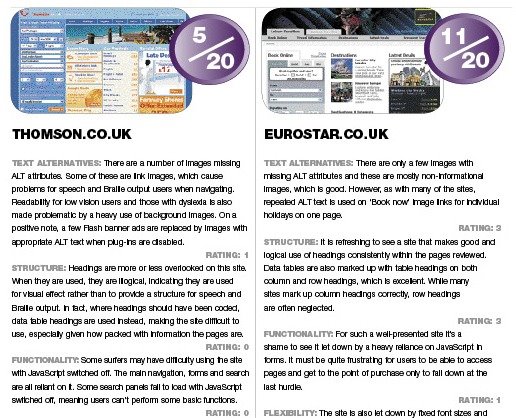
A few years ago the issue of accessibility came to the attention of the online community once again as the Disability Discrimination Act came into play.

We picked eight leading travel-related websites and asked the Royal National Institute for the Blind to scrutinise them in areas that might have an impact on disabled users.

These include Keyboard Access, Text Alternatives and Flexibility.

According to the RNIB’s senior web accessibility consultant, Henny Swan, none of the eight sites (Expedia, Ebookers, Thomson, Eurostar, Ryanair, Flightcentre, Cheapflights and Marriott) have come out of the test with a huge amount of glory.

Some are strong in a particular area, while others are doing well with another aspect.

[Read the full article here]

The purpose of the exercise has been to highlight the wider issue of web accessibility for consumers with a disability – nothing more.

The RNIB, to who we are enormously grateful for carrying out the tests using their collection of technological gizmos and through personal use, feels the travel industry needs a gentle reminder with regards to this area.

Apart from the frustration that some users may experience with some travel websites, from a business perspective the industry is also missing out if it is unable to target users with some form of disability.

Obviously we welcome all feedback with regards to this or any other feature [kevin.may@rbi.co.uk]. Or just leave a comment on the Blog.

Kevin May, editor, Travolution

Wednesday, April 19, 2006

Google denies Troogle

PING! An email from Google Towers responding to a query about yesterday's speculation in the national press about a new travel product from the search giant.

Wrong, wrong, wrong, pretty much sums up their reaction to a small piece in The Times that suggested a presentation was being planned in London by Google to unveil a "travel vertical" to rival the likes of Expedia and Travelocity.

[Read our post yesterday and The Times story]

According to Google, The Times spotted on advert running in the US for a travel team manager who will "develop our advertising business", based in Seattle.

The paper was wrong to imply that a so-called "travel vertical" automatically equates to a internet travel site, our source suggested.

The presentation in London did not take place either.

In short, Google is denying The Times story per se, but it remains somewhat coy about the Troogle concept in principle.

Thickening of plots. Speculation mounting. Even the mighty Google is struggling to stall the momentum of the rumour mill within the industry for this development.

Kevin May, editor, Travolution

Tuesday, April 18, 2006

Troogle: the story continues

So here we go - perhaps.

The national press - on this occasion, The Times - appears to be onto something with the Troogle story.

Today, in a story in its business pages, the paper claimed Google "is expected to confirm that it is launching an internet travel site to compete with successful portals such as Expedia and Travelocity" - pointing out that rumours have been rife on the internet.

[Read our posts in March: "Bring on the Troogle..." and "More on the Troogle front"]

No word from Google Towers as yet.

Kevin May, editor, Travolution

Monday, April 17, 2006

A classic romance…beautifully told

This was the strapline on a poster, seen just yards along from a restaurant where the boss of booming travel website predicted the love affair between the industry and the search engines was coming to an end.

The film tells the story of a couple who, predictably, battle the outside world in a desire to let their love blossom (you know the format for these tales by now).

But, inevitably, it all ends in disaster.

This is a rough translation for a theory, put forward by at least half a dozen or so senior figures in recent weeks and argued so passionately over lunch last week by another company chief, about where the industry’s obsession with search engines will lead.

The reason for these recent forecasts is this: the search engine model for reaching out to travel consumers is primarily an advertising medium.

It is estimated that the amount of money spent by travel-related companies on advertising on search engines stood at around $3 billion globally during 2005.

The relentless growth of online advertising through search is good for the sector as a whole but it is an inefficient means for the travel industry, where inventory (estimated at around $35 billion) needs to be shifted.

So what better way to shift stock than by the direct method, either through price comparison sites (Meta search) or straight to the consumer via registered special offer emails

In short, the most reliable method for shifting travel products is to target consumers when they actually want to make a purchase, rather through the lottery system – as some call it – of the search engine model.

[It is worth pointing out that last week’s forecaster was NOT from a price comparison site]

And so at some point in the next year or two the love affair between travel companies and search engines will apparently come to an end.

It’s a wild prediction and one that doesn’t take into account the muscle and ingenuity of the likes of Google and MSN (Yahoo! already has its own Kelkoo Meta search brand) to hit back.

But the Wild-Eyed Few – as we shall now call them – are so confident of this theory that they are willing to bet that the industry will eventually move this way, primarily as users grow increasingly frustrated at not finding the right product through the hundreds of pages of search results.

Kevin May, editor, Travolution

Wednesday, April 12, 2006

Page Three is the benchmark

Doom and gloom descends on the eve of Easter, perhaps, for those struggling to make it anyway close to the top on the likes of Google and Yahoo!.

A survey by those clever folk at JupiterResearch and IProspect reveals that 90% of internet users only go as far as Page Three before clicking on a result on a search engine.

Around 60% click on a website listed on the first page, the survey said.

This is a significant increase on figures from a similar study in 2002, which said 40% of users clicked on first page listings and 80% often waited until Page Three before picking a website.

This is good news for those with the buying power to appear high up on paid-for listings or with the ability to optimise their websites to appear in prominent positions in natural search.

For the others struggling to get a good spot on search engine listings the bar has been raised a notch higher again.

Danny Sullivan from Search Engine Watch, in an interview on the BBC News website, said the survey was “another call for search engines to look at their performance”.

But is it also the time for travel companies to re-think how they get their message out?

Kevin May, editor, Travolution

Monday, April 10, 2006

Tour operators face more than just an angry Mr Smith

Jeremy Skidmore, in a comment piece posted on the TravelMole newswire, has raised some interesting points about the role of blogging and, more importantly, customer service.

He says tour operators shouldn’t try and counteract the effect of blogs springing up and slamming them for every misdemeanour by launching their own “laughable” efforts by staff.

It’s very true – some of the staff-led ones are hilariously biased [it would probably not be sensible to link to them from here].

What Jeremy suggests is for tour operators to “up their game” in the way they handle complaints from customers, therefore getting to the route of the problem before the desire to go public and (often) create merry mayhem.

In the meantime his comments have been given a ringing endorsement from head of consumer affairs at the Association of British Travel Agents, Keith Richards.

But is it really that simple? Will tour operators suddenly become experts at handling the woes of customers? [“Ah, yes, Mr Smith, by way of apology for having a disco beneath your holiday apartment in Spain, we will send you and your wife some flowers and a CD of chilled out classical numbers.”]

It could be argued that despite the advances of recent years the tour operators actually still have a long way to go if they want to head off the so-called threat from anger-fuelled blogs or damaging conversations read on consumer forums.

Tour operators aren’t becoming less adept at handling complaints – it’s just that the web-savvy consumer is become more prevalent and knows where to go to get its voice heard.

And it’s not just sites belonging to individuals that wield such power.

Some suggest sites such as Trip Advisor are playing into the hands of emotional users, who in turn can often create controversial content, but can also provide valuable information about a particular product.

Interestingly the UK version of Trip Advisor, which launched in January, will soon allow users to post comments about individual tour operators – a major development for the site – as well as the traditional appeal for praise or criticism of a hotel, location, restaurant or bar.

Tour operators certainly have a challenging time ahead.

Kevin May, editor, Travolution

Friday, April 07, 2006

A way to personalise

So another week is over and another edition of Travolution is safely tucked away in the land of nod for 10 days or so until it hits the desks of readers.

Our print edition, getting ready for its third outing, has already caught the imagination of the industry in many ways – which was always our primary goal.

But someone asked me today how the Blog is doing. A reasonable question seeing as it’s also been attracting quite a bit of attention recently.

For fear of boring readers with traffic figures (very good, if you’re asking), I’ve been issuing a standard response to this question.

The success of the Travolution Blog, we feel, demonstrates a subtle shift within the online community – though it’s far from being a new phenomenon – and which the travel industry should perhaps take notice.

Online users or customers (indeed, Travolution’s customers!) are looking for new and interesting ways to access information or products.

Blogging – which for many people still sounds like something you might found yourself doing in a dark alley – is another form of communicating.

The Guardian, for instance, has recently launched of a collection of Blogs across its portfolio of online products. The BBC’s political editor Nick Robinson also has a fantastic Blog.

And then there are those with “self-indulgent twaddle” syndrome (as a former colleague of mine calls it).

Some private Blogs fit that category perfectly (journalists, interestingly, do not necessarily make for the best bloggers), but for businesses the world of blogging is still a relatively unexplored medium that, if done well, can capture the interest of customers.

Indeed the travel industry is ripe for blogging. Customers want to get involved and share their experiences – travel companies inevitably have plenty of characters that can amuse, entertain or provoke users. If personalisation is the next stage, then blogging will help.

It’s all just part of the service.

Kevin May, editor, Travolution

Lazy Frog - Part 2

So low-cost airline Jet2 saw a substantial uplift in traffic to its website following chief executive Philip Meeson’s comments about striking French workers.

[Read Heather Hopkins from Hitwise’s post here]

Many readers of the story on the BBC, for example, would have been curious as to what Meeson actually said in his article on the airline’s website, and probably decided to see if the story had been pulled following criticism from French unions representing air traffic controllers.

Others, not knowing who Jet2 are, possibly, would have been curious enough to take a peak at the airline’s site anyway.

Of course the company hasn’t bowed to any of the pressure and removed the offending article, as they say, from its site.

Meeson was obviously a bit peeved at problems across the English Channel affecting its services (disruption mainly to its services in and out of Leeds-Bradford airport), but sceptics might wonder whether the decision to go public with such a frank and barbed statement was driven more by the marketing department.

The cut-throat world of the small to medium sized low-cost airline, battling against the high profile carriers that have upped their game online to offer cheap fares across Europe, may have played a part in the past week’s activities.

The internet, while allowing the likes of Jet2 to reach a mass market like never before, is also forcing those without the marketing muscle of Ryanair, EasyJet and BA.com to think, erm, cleverly about drumming up brand awareness.

Arjo Ghosh from Spannerworks, during an event at the Association of British Travel Agents last week, said publicity stunts and PR can go a long way to boosting traffic to a site.

Now having a pop at striking French air traffic controllers might be 1) a bit obvious or 2) risks alienating those that may actually sympathise with them.

But of course the page where the story is located also features a plug for its summer 2007 tickets. And if Jet2 sells a flight from Blackpool to Spain for next year, then perhaps it might all be worthwhile.

A risky strategy for Jet2, of course, but as we used to say at the Essex Enquirer, my old local paper: “Any publicity is good publicity."

[A small and utterly indiscreet plug for Travolution here – airlines, their web strategy and the power they now wield is an issue close to our hearts and will feature heavily in the April edition of the magazine]

Kevin May, editor, Travolution

Thursday, April 06, 2006

Lazy Frog - Part 1

Hitwise daily data reveals that this week's comments by Jet2's boss about the French air traffic controllers, resulted in a spike in visits to Jet2's website.

In a press release on the airline's site, chief executive Philip Meeson wrote that the company "condemns French strike action and calls for lazy frogs to get back to work!".

Keeping alive the rivalry between the French and the Brits, UK internet users rallied to the Jet2 website over the past two days.

According to Hitwise data, market share of UK internet visits were up 26% yesterday (5th April 2006) compared with the day of the flight disruption (3rd April 2006).

This was the second largest share of visits the site has attracted since early February.

The second highest referrer of visits to Jet2.com yesterday was Easyjet, who was also affected by the disruption and who supported Meeson's comments.

Easyjet was quoted by Scotsman.com as saying that UK airlines were having to pay the cost of the French "not bothering to do a decent day's work".

Heather Hopkins, director of research at online analyst, Hitwise

Read more from Heather's Blog here

Wednesday, April 05, 2006

Things to avoid on press day

#1 Responding to poorly targeted emails from PR agencies trying to flog laptop bags (Ok, so I guess we are media brand writing for people that probably own a laptop).

#2 Responding to poorly targeted emails from PR agencies trying to flog state-of-the-art roof racks (Yes, yes, we are also a media brand writing about travel, but come on...).

#3 Blogging.

Full service resumes shortly! But only after I've dealt with those poorly targeted emails.

Kevin May, editor, Travolution

Monday, April 03, 2006

Mantra for a new age

Coming back from a weekend on the South Coast, a pal – who, thankfully, has more than a passing interest in the travel industry – asked me what was the most interesting trend to emerge so far in 2006.

The contents of the Travolution Blog would lead many readers to suggest that the issue of search is consuming us all.

Indeed, a fly on the wall at last week’s Travolution-hosted seminar at the Association of British Travel Agents would probably hang around for a while before buzzing off (as it were) – probably looking for the exit marked “This Way For No More Search-Related Discussions".

Search is clearly dominating an extraordinarily high amount of Travolution and the industry’s conversation time at the moment. But it isn’t the most significant change on Planet Online Travel, in our opinion.

So perhaps it is the burgeoning consumer-generated content area of the industry? [Trip Advisor UK is an interesting development and has so far been dismissed or praised in equal measures by most people]

Maybe it’s the enthusiasm for price comparison sites, demonstrated last week by the launch of new player on the scene Henoo.com?

Nope.

Unfortunately it is something far less tangible than the launch of a site.

Speak to a number of key industry figures and they will tell you that the internet is finally establishing itself as the direct route for products – a move that, firstly, has massive implications for any supplier of air tickets, hotels and car hire but, more importantly, a change that will test the resolve of those that have so far only acted as intermediaries.

As the internet moves to becoming the mass market(ing) medium, sellers will want to reach those consumers in the quickest, cheapest way.

While this will certainly keep the search engines in business, those acting as online broking houses for products will, if some watchers are to be believed, find themselves squeezed out as consumers rely increasingly on trusted brands.

This certainly doesn’t mean the end for the intermediaries nor, of course, the package holiday providers – especially in the UK.

It simply demonstrates that the increase in consumption of the internet (welcomed pretty universally by most people, it must be noted) will conversely put enormous pressure on those without the power to influence consumers.

Direct sales + branding + search + loyalty = success, is the new internet mantra, someone said recently. This, in theory, is a simple equation, but one increasingly difficult to solve, in reality.

[For those that might be slightly interested, my pal and I discussed this issue during the time it took our train to travel from Ashford to Bromley South – on a Sunday stopping service!]

Kevin May, editor, Travolution